
How to Choose the Right Offshore Software Development Company
 Probits
Choosing the right software development company can be challenging, especially when you are building a new product, launching an MVP, or scaling an existing digital platform. For Australian businesses, working with an offshore software development company can provide access to specialised technical talent, flexible development teams, and potentially lower development costs.
However, not every offshore development company offers the same level of expertise, communication, security, or reliability. Choosing the wrong partner can result in missed deadlines, unexpected costs, poor-quality code, and difficult communication.
So, how do you choose the right offshore software development company?
The key is to evaluate a potential partner beyond their pricing. You need to consider their technical capabilities, previous projects, development process, communication, security practices, scalability, and ability to understand your business goals.
This guide explains the key factors Australian startups and businesses should consider before choosing an offshore software development partner.
What Is an Offshore Software Development Company?
An offshore software development company provides software development services to businesses from another country or region.
Instead of hiring an entire in-house development team, a business can work with an external team that handles some or all aspects of custom software development. Depending on the project requirements, an offshore development team may include software developers, UI/UX designers, project managers, QA engineers, DevOps specialists, business analysts, technical architects, and AI and machine learning specialists.
For example, an Australian startup may work with a software development company that has a local presence in Australia and a technology delivery team in another country. This model can provide access to a broader talent pool while maintaining local communication, project oversight, and development support.
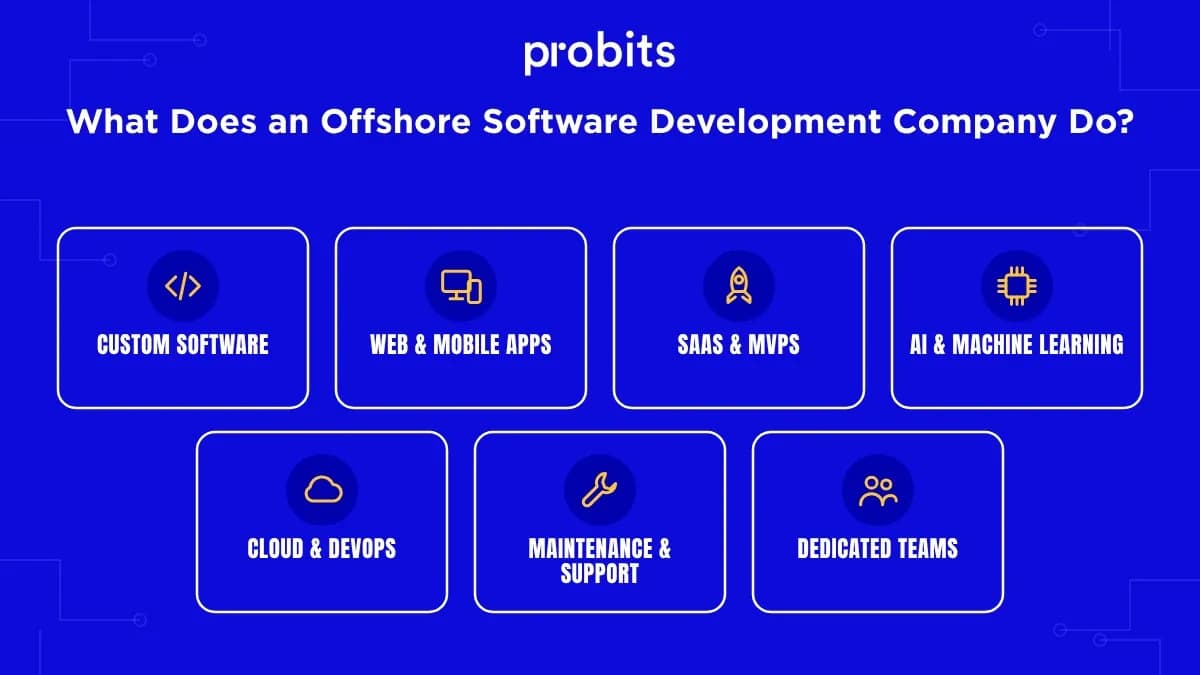
Offshore development can be used for:
- Custom software development
- Mobile app development
- Web application development
- SaaS product development
- MVP development
- AI and machine learning projects
- Cloud and DevOps
- Software maintenance and support
- Dedicated development teams
The important part is finding a partner that fits your specific project rather than choosing a provider based only on location or price.
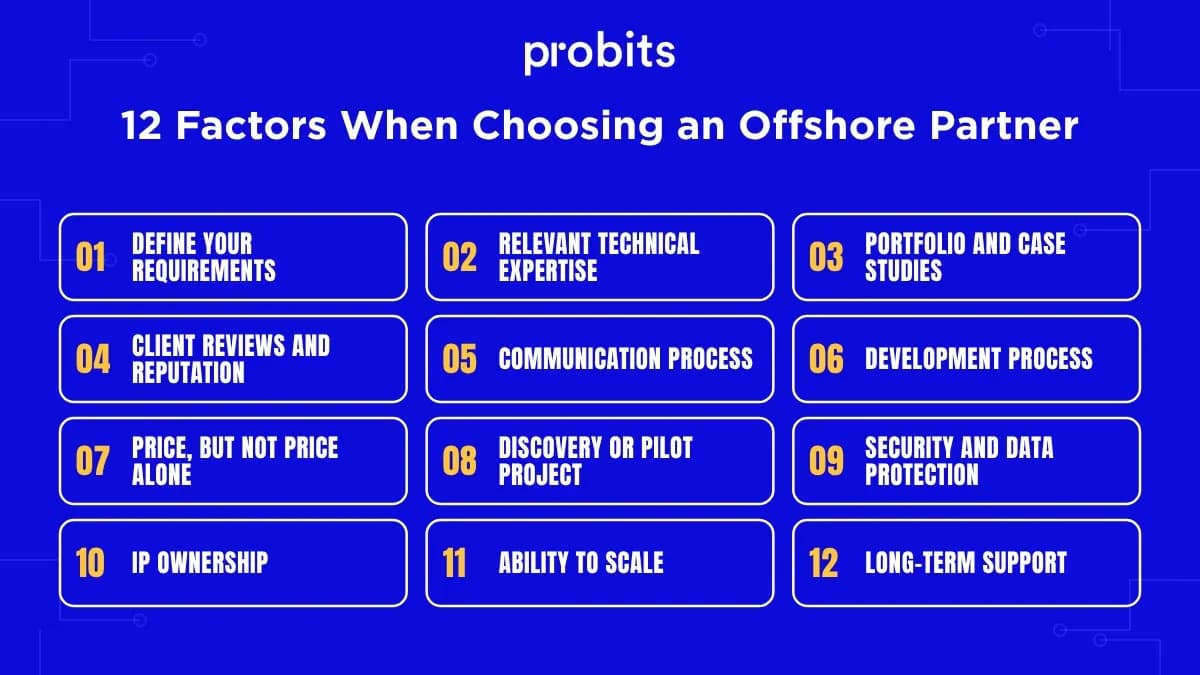
12 Key Factors to Consider for an Offshore Software Company
1. Define Your Project Requirements First
Before comparing offshore software development companies, understand what you actually need. You do not necessarily need a complete technical specification before contacting development companies. However, you should have a clear understanding of the business problem you are trying to solve.
Start by identifying:
- What product or software do you want to build?
- Who will use it?
- What are the most important features?
- Do you need a web application, mobile app, SaaS platform, or custom software?
- Are you building an MVP or a complete product?
- What technology requirements do you already have?
- What is your expected timeline?
- What is your approximate budget?
- Will you need ongoing maintenance and support?
For example, a startup building a healthcare platform may need secure user authentication, appointment management, notifications, payments, and integrations with existing systems.
Having these requirements ready makes it easier to compare different offshore development teams and determine whether they have the right experience.
Short-Term vs Long-Term Goals
Consider what you want from the development relationship.
"Are you trying to quickly build an MVP to validate an idea or attract investors?" Or "Are you looking for a long-term technology team that can continuously develop and maintain your product?"
Knowing this upfront can help you choose a company that can support both your immediate requirements and future growth.
Be Clear About Your Budget and Timeline
Budget and timeline are two of the most important factors when choosing a development company. Set realistic expectations before approaching potential partners. This will help you identify companies that can deliver within your financial and time constraints. It also gives development companies enough information to provide more accurate estimates.
2. Look for Relevant Technical Expertise
One of the most important factors when choosing an offshore software development company is technical expertise. A company may have experienced developers, but that does not automatically mean they are suitable for your project. Look for experience with the technologies and development approaches your product requires.
Depending on your project, this could include:
- React or Next.js
- Node.js
- Python
- Java
- .NET
- Flutter
- React Native
- AWS
- Microsoft Azure
- Google Cloud
- AI and machine learning
- APIs and third-party integrations
- Database development
- DevOps and cloud infrastructure
You should also look at the company's experience solving problems similar to yours. For example, if you are developing an AI-powered SaaS platform, a company that primarily builds simple websites may not be the right fit. You should look for a development company with experience in SaaS architecture, APIs, cloud infrastructure, data handling, and AI integration.
Technical expertise should match the complexity and requirements of your product.
3. Review Their Portfolio and Case Studies
A portfolio can tell you much more about a software development company than its marketing claims.
When reviewing a company's portfolio, look for case studies that explain:
- What problem did the client have?
- What solution was developed?
- Which technologies were used?
- How the development process worked
- What challenges the team solved
- What results did the client achieve?
Pay particular attention to projects similar to yours. For example, if you want to develop a logistics platform, look for evidence that the company has worked with logistics, transportation, fleet management, marketplaces, or other systems involving complex workflows.
A strong portfolio demonstrates not only coding ability but also the company's ability to understand business requirements and turn them into practical software solutions.
4. Check Client Reviews and Reputation
Do not rely entirely on testimonials published on a company's own website. Research independent reviews and feedback from previous clients. Platforms such as Clutch and GoodFirms can help you compare software development companies based on client experiences.
When reviewing feedback, pay attention to recurring comments about:
- Communication
- Project management
- Technical expertise
- Meeting deadlines
- Responsiveness
- Code quality
- Transparency
- Problem-solving
- Post-launch support
A company with a few negative reviews is not necessarily a bad choice. Look for patterns across multiple reviews rather than judging a company from one comment. You can also ask potential partners whether they can provide references from previous clients. First-hand feedback can help you understand what it is actually like to work with the company.
5. Evaluate Their Communication Process
Communication is one of the biggest challenges businesses can face when working with an offshore development team. Time-zone differences, unclear requirements, slow responses, and inconsistent project updates can create unnecessary delays. Before signing a contract, ask how the company manages communication.
Find out:
- Which communication tools do they use?
- How frequently will you receive project updates?
- Who will be your primary contact?
- What are their working hours?
- How do they handle urgent issues?
- How are requirements and changes documented?
- How often will meetings take place?
A good offshore software development company should have a clear communication process rather than leaving clients wondering what is happening with their project. For Australian businesses, it can also be useful to work with a company that understands Australian business practices and can provide convenient communication across relevant time zones.
6. Understand Their Development Process
A reliable development company should be able to clearly explain how it takes a project from an idea to a working product.
Ask about its process for:
- Discovery and requirements
- Project planning
- UI/UX design
- Development
- Testing and quality assurance
- Deployment
- Monitoring
- Maintenance and support
Many software companies use Agile development methodologies, allowing teams to develop and review products in smaller stages. This can be particularly useful for startups because requirements often change as users provide feedback.
Instead of spending months building a product without validation, an Agile approach can allow businesses to release smaller versions, collect feedback, and improve the product over time.
A clearly defined development process also makes it easier to understand responsibilities, timelines, deliverables, and milestones.
7. Compare Pricing, but Don't Choose Based Only on Cost
Cost is one of the major reasons businesses consider offshore software development. However, the cheapest provider is rarely automatically the best choice. A lower hourly rate can become expensive if the development team produces poor-quality work, requires significant rework, or consistently misses deadlines. When comparing offshore software development companies, consider the total value rather than just the hourly rate.
Ask for a clear breakdown of:
- Development costs
- Design costs
- Project management
- Testing and QA
- Infrastructure costs
- Third-party services
- Maintenance
- Post-launch support
Also clarify how changes to the original requirements will be handled. A transparent pricing structure makes it easier to manage your budget and reduces the risk of unexpected expenses later. The goal should not simply be to find the cheapest offshore development team. It should be to find a company that provides reliable results within your budget.
8. Start With a Discovery or Pilot Project
If you are unsure about a potential partner, you do not necessarily need to commit to a large project immediately. A smaller discovery or pilot project can help you evaluate the company's capabilities before moving forward.
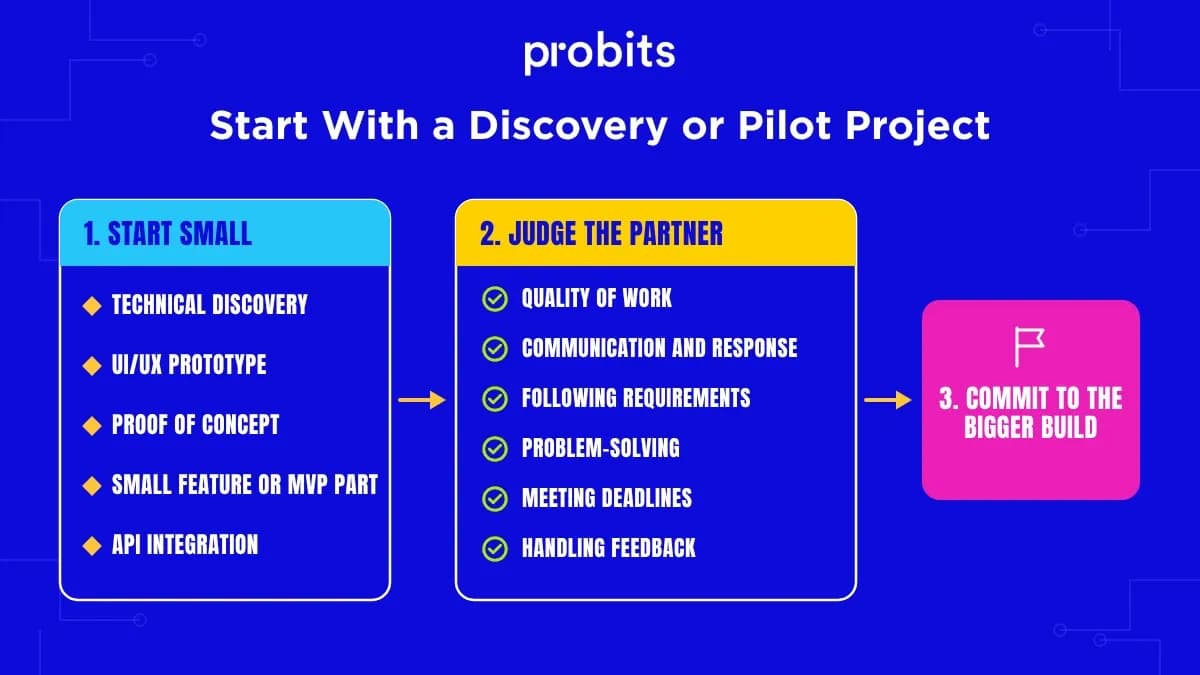
For example, you could start with:
- Technical discovery
- UI/UX prototype
- Proof of concept
- Small application feature
- MVP component
- API integration
During this stage, evaluate:
- Quality of work
- Communication
- Response time
- Ability to follow requirements
- Technical problem-solving
- Ability to meet deadlines
- Willingness to accept feedback
A successful pilot can give you much more confidence than a sales presentation. It also allows both sides to determine whether the working relationship is a good fit before committing to a larger engagement.
9. Check Security and Data Protection Practices
Security should be a priority when outsourcing software development. Your development company may have access to source code, databases, business information, customer data, infrastructure, and other sensitive assets. Before working with a company, ask about its security practices.
Depending on your project, this may include:
- Secure development practices
- Access controls
- Code repository permissions
- Data encryption
- Secure authentication
- Vulnerability testing
- Backup procedures
- Secure cloud infrastructure
- Employee access policies
- Confidentiality agreements
The Australian Signals Directorate (ASD) and Australian Cyber Security Centre (ACSC) recommend practices such as secure coding, separating development and production environments, strong access controls, security testing, and careful management of third-party software.
When choosing an offshore software development company, ask who can access your systems and source code, how sensitive data is protected, and how vulnerabilities and user access are managed. If your software handles sensitive or regulated data, ensure your development partner understands the relevant Australian compliance requirements.
Security should be built into the development process from the beginning, not addressed after a problem occurs.
10. Clarify Intellectual Property Ownership
Before development begins, make sure your contract clearly explains who owns the software and intellectual property.
The agreement should address ownership of:
- Source code
- Designs
- Documentation
- Databases
- Custom APIs
- Technical assets
- Product specifications
- Other project deliverables
You should also clarify whether the development company intends to reuse any frameworks, libraries, templates, or pre-existing components. A clear agreement can prevent disputes later and ensures both parties understand their responsibilities. For businesses sharing confidential product ideas, signing a Non-Disclosure Agreement (NDA) before exchanging sensitive information may also be appropriate. Do not leave intellectual property ownership until the end of the project. It should be clearly defined in the agreement before development starts.
11. Make Sure the Team Can Scale
Your software requirements may change as your business grows.
A startup might initially need two developers and a designer to build an MVP. After launch, it may need additional developers, QA engineers, DevOps specialists, or AI engineers. Ask potential offshore development companies how easily they can scale their team. A flexible development company should be able to adjust resources based on your requirements.
This is especially useful when:
- Launching an MVP
- Adding new features
- Entering new markets
- Scaling infrastructure
- Rebuilding legacy software
- Increasing development speed
The ability to scale can make an offshore development partnership more valuable over the long term.
12. Consider Long-Term Support
Software development does not end when the product launches. After launch, your software may require:
- Bug fixes
- Security updates
- Performance optimisation
- New features
- Infrastructure management
- Third-party integrations
- Monitoring
- Technical support
Before choosing a development company, ask whether it provides ongoing maintenance and support.
A company that understands your product from the beginning can often provide valuable support after launch because the team already understands the architecture, codebase, and business requirements. This can also reduce the time required to onboard a completely new team when you need future changes.
Choosing Between Offshore and Local Software Development
Choosing between offshore and local software development in Australia depends on your budget, project complexity, communication needs, and long-term goals.
- Local software development: Offers easier face-to-face communication and a strong understanding of the Australian market.
- Offshore software development: Gives Australian businesses access to a wider talent pool, specialised technical expertise, and potentially more cost-effective development.
- Hybrid development: Combines local project management with an offshore development team for technical delivery.
For many Australian businesses, a hybrid software development model can provide the right balance of local support, technical expertise, scalability, and cost efficiency.
Common Offshore Development Mistakes to Avoid
Choosing an offshore software development company based only on price can lead to quality, communication, and project management issues.
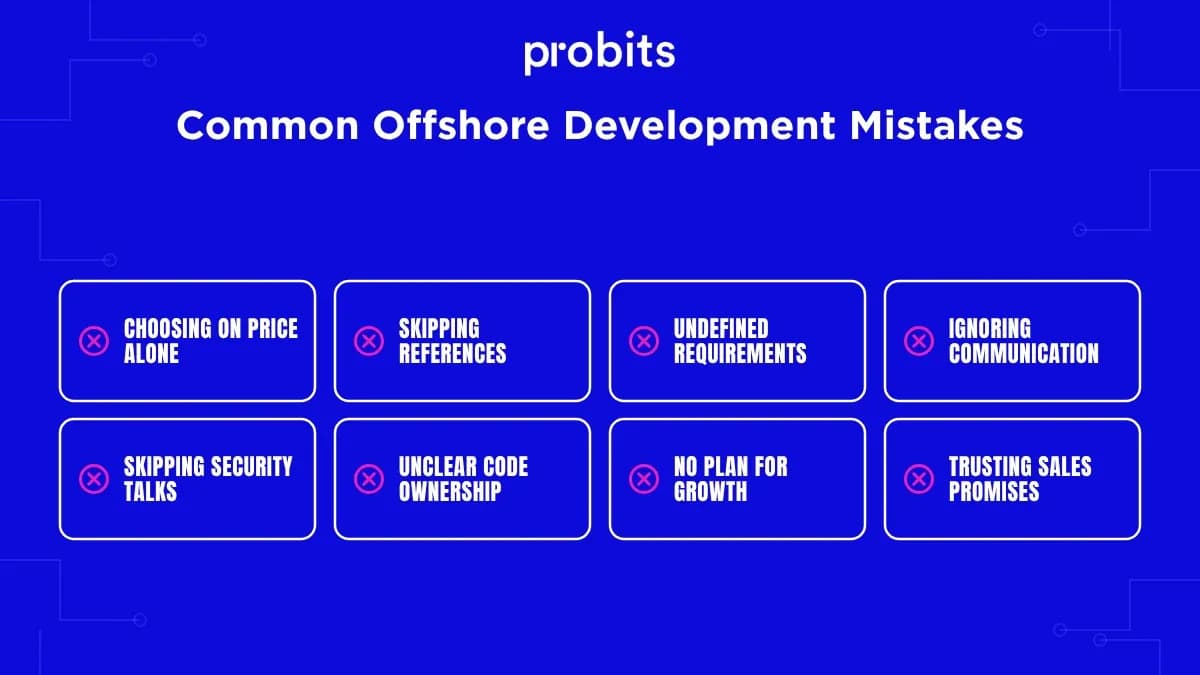
Avoid these common mistakes:
1. Choosing Based Only on Price: The cheapest option may not provide the best value. Compare technical expertise, quality, communication, support, and overall project value.
2. Not Checking References and Reviews: Don’t rely only on a company’s website. Check independent reviews, case studies, and previous client experiences.
3. Not Defining Project Requirements: Unclear requirements can cause scope changes, delays, misunderstandings, and unexpected costs.
4. Ignoring Communication: Consider time-zone overlap, communication channels, reporting processes, and response times before hiring an offshore development team.
5. Skipping Security Discussions: Discuss data protection, access controls, secure development practices, and compliance requirements before development begins.
6. Not Clarifying Ownership: Ensure your agreement clearly defines ownership of source code, designs, documentation, and other intellectual property.
7. Not Planning for Future Growth: Choose an offshore development partner that can scale the team and provide ongoing maintenance, support, and new feature development.
8. Relying on Sales Promises: Validate claims through case studies, technical discussions, client references, and a discovery or pilot project where appropriate.
How Probits Supports Offshore Software Development Services
Probits is a software development company that helps Australian businesses and startups build digital products, combining local Australian support with a skilled development team in Nepal to provide offshore software development expertise.
We support businesses throughout the software development process, from planning and MVP development to custom software, web and mobile app development, AI solutions, and ongoing support. Businesses can also work with dedicated development teams or add offshore developers to their existing teams when they need extra technical support.
By combining Australian support with offshore development resources in Nepal, Probits helps businesses access skilled developers, maintain clear communication, and build scalable software without the cost of maintaining a large in-house team.
Frequently Asked Questions
How much does offshore software development cost?
The cost depends on the project’s complexity, features, technology, team size, and development location. Compare overall value, technical expertise, quality, and support rather than choosing a company based only on the lowest price.
Is offshore software development suitable for Australian businesses?
Yes. Australian businesses can use offshore development teams to access specialised technical talent, scale their teams, and manage development costs while maintaining local project management or business support.
What should I ask an offshore software development company before hiring them?
Ask about their technical expertise, previous projects, development process, communication, pricing, security practices, intellectual property ownership, team structure, scalability, and ongoing support.
Can an offshore development team work with my existing team?
Yes. An offshore development team can work alongside your internal developers, designers, project managers, or other technology teams. This can be useful when you need additional technical expertise or development capacity.
How can I manage communication with an offshore development team?
Set clear communication channels, meeting schedules, reporting processes, responsibilities, and response expectations. Choosing a team with suitable time-zone overlap can also make collaboration easier.
Conclusion
Choosing the right offshore software development company is about more than finding the lowest price. Look for a partner with the right technical expertise, proven experience, clear communication, strong security practices, transparent pricing, and the ability to support your project as it grows.
For Australian businesses, an offshore or hybrid development model can provide access to skilled technical talent while maintaining local communication and support.
Looking for an offshore development partner for your next software project? Probits helps Australian businesses and startups build, scale, and maintain digital products with local support and an experienced development team in Nepal. Talk to Probits to discuss your project and find the right development approach for your business.