
Custom Software Development Examples: 10 Real Australian Use Cases
 Niresh Lamsal
Custom software development examples range from a grocery price comparison app with 80,000 users to the NSW digital driver licence. Below are ten real Australian use cases: five apps from the 25+ projects our team has delivered, and five well-known public projects, including two that went wrong and what they teach anyone commissioning software.
If one of them looks like your problem, our custom software development team can talk it through with you.
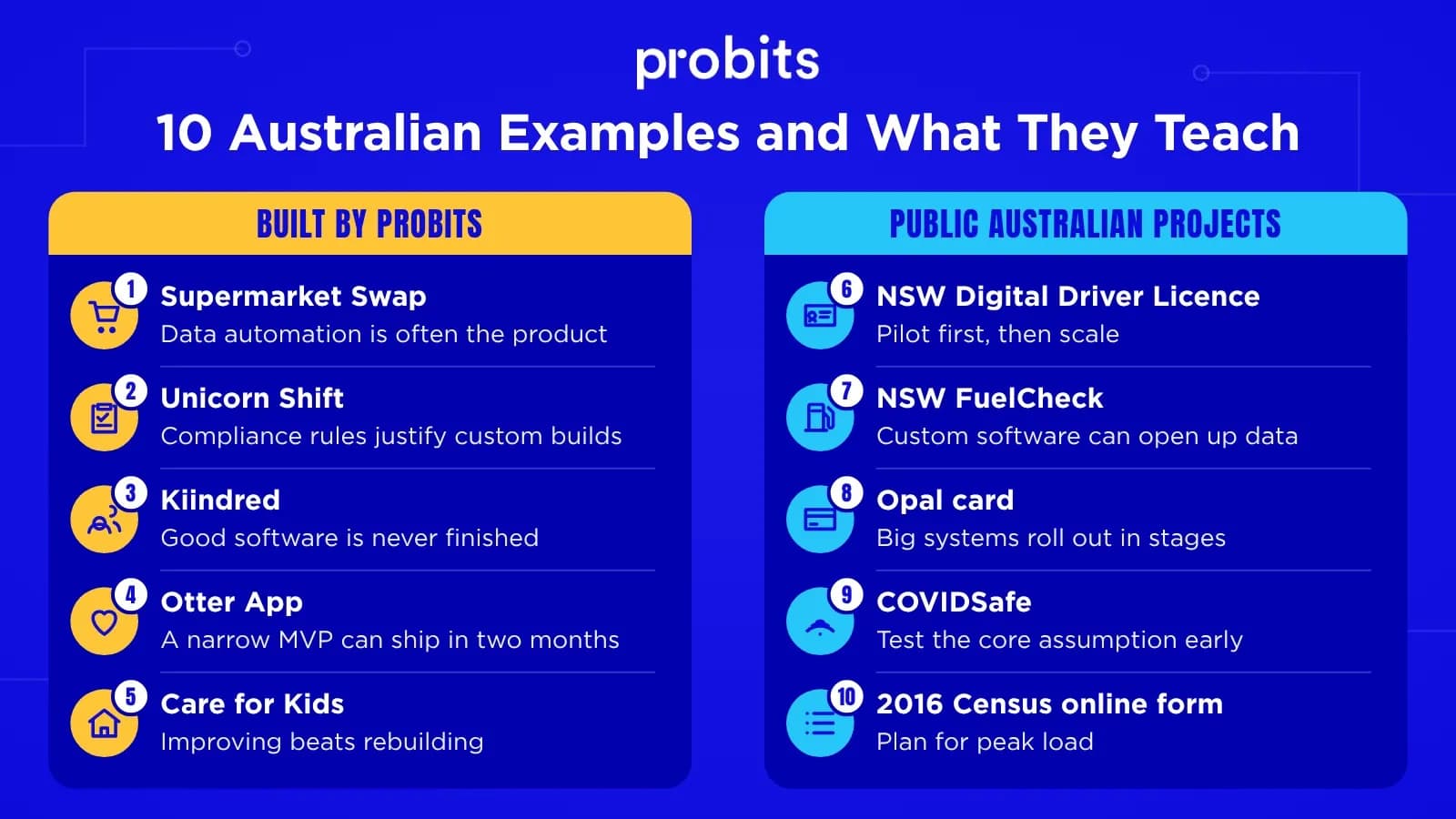
The 10 examples at a glance
| # | Example | Type | Built by | Lesson |
|---|---|---|---|---|
| 1 | Supermarket Swap | Price comparison app | Probits | Data automation is often the product |
| 2 | Unicorn Shift | Industry workflow platform | Probits | Compliance rules justify custom builds |
| 3 | Kiindred | Parenting app and platform | Probits | Good software is never "finished" |
| 4 | Otter App | Consumer MVP | Probits | A narrow MVP can ship in two months |
| 5 | Care for Kids | Web platform modernisation | Probits | Improving beats rebuilding |
| 6 | NSW Digital Driver Licence | Government service app | NSW Government | Pilot first, then scale |
| 7 | NSW FuelCheck | Real-time price data | NSW Government | Custom software can open up data |
| 8 | Opal card | Transport ticketing | Transport for NSW | Big systems roll out in stages |
| 9 | COVIDSafe | Public health app | Australian Government | Test the core assumption early |
| 10 | 2016 Census online form | High-traffic web form | ABS and IBM | Plan for peak load |
Examples our team built
1. Supermarket Swap: grocery price comparison
Supermarket Swap compares grocery prices across Woolworths and Coles and helps users plan meals around the cheapest options. When it came to us, the founders had been through a previous developer, the code was hard to follow, and product data was updated largely by hand.
We standardised the codebase and automated the price collection from both supermarkets. Manual data work dropped from about four hours to one, and the app has grown past 80,000 users.
Why custom: no off-the-shelf product compared live Woolworths and Coles prices. The comparison engine is the business.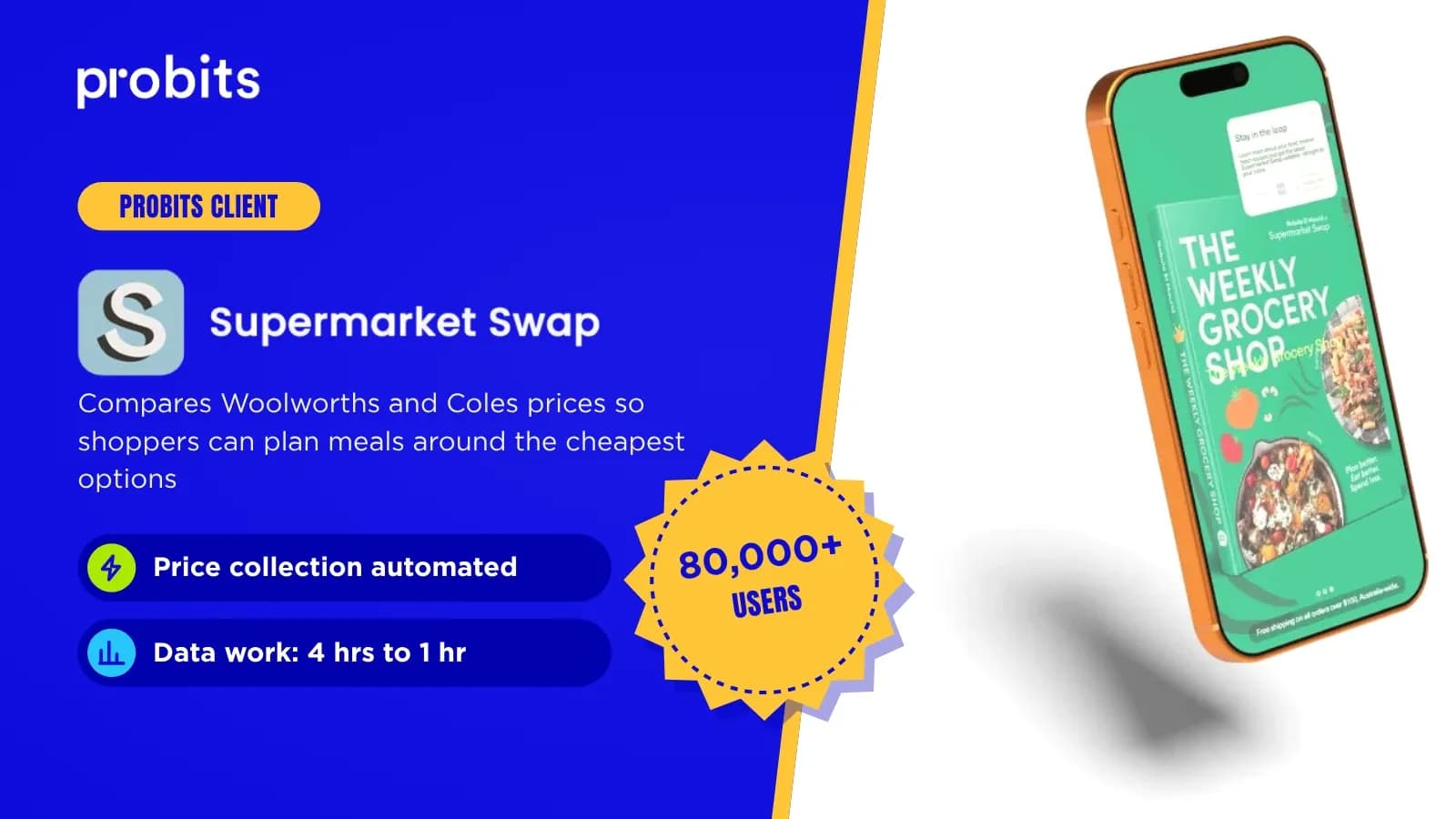
2. Unicorn Shift: civil infrastructure workflow
Unicorn Shift connects contractors, suppliers and buyers in Australia's civil infrastructure industry, starting with traffic management. Before work starts on a road, a contractor needs approvals and traffic plans in place, and the paperwork changes by state.
We built the platform's unplanned job module on Node.js, GraphQL, React and AWS. Contractors can create, clone and track jobs, request rates from several suppliers at once, and notify suppliers automatically when plans change.
Why custom: generic project tools don't encode state-by-state approval rules. When compliance logic is your workflow, you usually end up building.
3. Kiindred: parenting app with personalisation
Kiindred is a Sydney-based parenting platform offering expert content and courses from pregnancy to the tween years. Its app was built on Expo and had started to show performance problems as the feature roadmap grew.
We started with a business analysis and code review, fixed performance first, then added features in stages, including machine-learning content suggestions, a chatbot for common parenting questions, and fraud detection. A five-person team (three developers, a project manager and a QA engineer) still maintains the app and the Kiincreators platform, more than five years on. The app has passed 25,000 downloads.
Why custom: the personalisation and content model are what make the product different.
4. Otter App: a two-month consumer MVP
Otter is a date-night app for couples in Sydney, built for a solo founder. It offers more than 1,000 customisable date ideas, recommendations based on time, place and mood, a timeline for saving memories, and a points system called Pebbles that rewards completed dates.
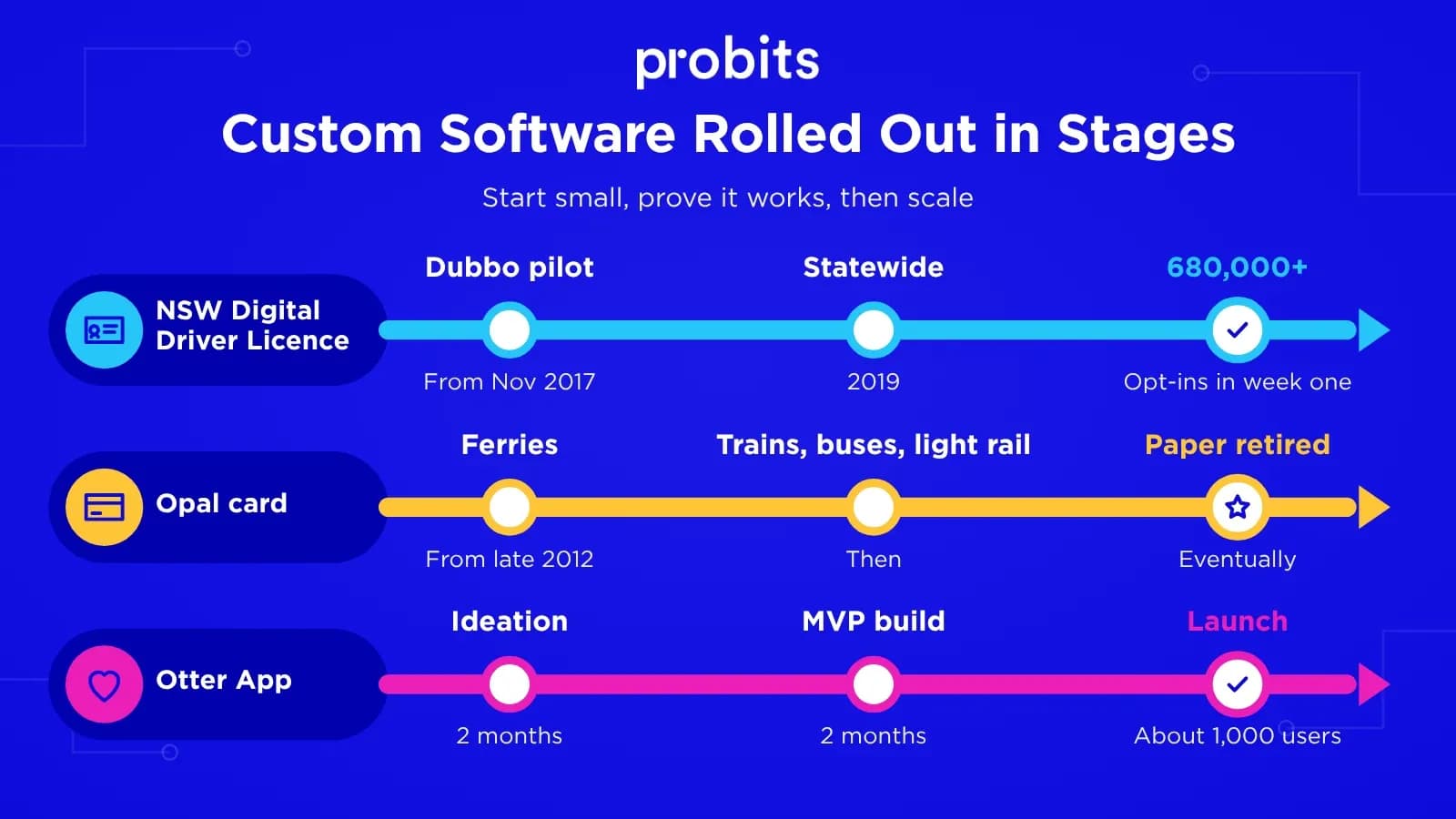
After a two-month ideation phase, the MVP was built in a two-month window on React Native, Next.js, Nest.js and PostgreSQL, and reached about 1,000 users.
Why custom: it's a new consumer product, so there's nothing to buy. The lesson is scope: a tightly defined first version can launch in weeks, not quarters. Cutting scope is also the main way to build an MVP on a budget.
5. Care for Kids: modernising an existing platform
Care for Kids helps Australian families find child care and early childhood education. The site was built on an older ASP.NET codebase.
Rather than rebuild it, we modernised the code, improved page speed and navigation, added a blog for parenting and child care advice, and worked with Kiin Agency, who handled the design.
Why custom: the platform already existed and worked. Improving it was cheaper and less risky than starting again, which is often the right call for a site with an established audience.
Well-known Australian examples
6. NSW Digital Driver Licence
Service NSW piloted a digital driver licence in Dubbo from November 2017 before rolling it out statewide in 2019. It needed new legislation (the Road Transport and Other Legislation Amendment (Digital Driver Licences and Photo Cards) Act 2018) and acceptance by police and licensed venues. More than 680,000 people opted in during the first week of the statewide launch.
Lesson: pilot in one place with real users before you scale, especially when other people (police, venue staff) have to trust what you've built.
7. NSW FuelCheck
Since 2016, NSW fuel retailers have had to report their prices in real time, and the FuelCheck app and website show them to drivers. The software is simple for the user, but it depends on getting accurate, timely data from thousands of service stations.
Lesson: custom software often earns its keep by collecting and opening up data that was scattered. It's the same idea as Supermarket Swap, at state scale.
8. Opal card
Transport for NSW rolled out the Opal smartcard in stages from late 2012, starting with ferries before extending across trains, buses and light rail. Paper tickets were eventually retired.
Lesson: big systems that replace something everyone uses go in by stages, one mode or region at a time. The same "slice by slice" approach works for replacing an old business system.
9. COVIDSafe
The federal government's contact-tracing app launched in April 2020 and was switched off in August 2022. Health Minister Mark Butler said it had cost about A$21 million and found only two positive cases.
Lesson: test the core assumption early and cheaply. COVIDSafe depended on Bluetooth working reliably in the background on iPhones, which proved hard. A small pilot measuring that one thing would have been worth more than a polished launch.
10. The 2016 Census online form
On census night, 9 August 2016, the Australian Bureau of Statistics took its online census form offline after a series of denial-of-service attacks and system problems, and millions of households couldn't submit. IBM, which delivered the system, later reached a settlement with the Commonwealth.
Lesson: if most of your users will arrive at once (a launch, a sale, a deadline), test for that peak and for attack traffic before go-live, not after.
What these custom software examples have in common
The successful ones had a clear reason they couldn't buy something off the shelf: live price data, state compliance rules, a new consumer idea. The two that struggled ran into an untested technical assumption and an untested peak load.
"The projects that worked all started with a problem you could describe in one sentence. That's usually the best sign a custom build will be worth it." Niresh Lamsal (CMO), Probits
The successful ones also went in by stages. The digital licence started in Dubbo, Opal started with ferries, Kiindred added features in stages, and Otter launched a narrow MVP. If you're planning your own build, start with the basics of what custom software development is and a realistic custom software development cost for your project type.
Frequently Asked Questions
What is an example of custom software?
A grocery price comparison app that pulls live prices from Woolworths and Coles, like Supermarket Swap, is custom software. So is a government app such as the NSW Digital Driver Licence. Both were built for one organisation's specific need rather than bought off the shelf.
What are common types of custom software?
Common types include internal workflow tools, customer portals, mobile apps, marketplaces, SaaS products, data and price comparison platforms, and modernised versions of older business systems.
Why do businesses build custom software instead of buying it?
Usually because no existing product does the job, the workflow is what makes the business different, or rules such as compliance requirements are too specific for a general product to handle.
What can go wrong with custom software projects?
Common problems include untested technical assumptions, systems that can't handle peak traffic, unclear scope and poor handover from previous developers. COVIDSafe and the 2016 Census are two well-known Australian examples.
How long does it take to build a custom app?
A narrow MVP can launch in about two months, as Otter App did. Most business applications take three to six months, and larger platforms six to twelve months or more.