
MVP Validation: How to Test Your Product Before Scaling
 Probits
Building a new product is exciting, but developing an idea without knowing whether customers actually need it can be expensive. Startups spend months and significant resources designing features, writing code, and preparing for launch, only to discover their product doesn't solve a problem people pay for. This is where MVP testing and MVP validation become important.
A Minimum Viable Product (MVP) is a simplified version of a product that includes the essential functionality needed to test an idea with real users — if you're not yet familiar with what an MVP actually is, it's worth starting there. Instead of investing heavily in a complete product from the beginning, startups can use an MVP to collect feedback, measure demand, identify problems, and make informed product decisions.
However, simply launching an MVP does not automatically validate an idea. Effective MVP validation requires clear assumptions, the right target users, meaningful success metrics, direct customer feedback, and continuous iteration.
In this guide, we explain how to validate an MVP, what to test, which metrics to track, common MVP testing mistakes, and when a startup should consider scaling its product.
What Is MVP Testing?
MVP testing is the process of putting a minimum viable product in front of real or representative users to determine whether it solves a meaningful problem and whether users are willing to engage with it.
The objective is not to prove that every feature works perfectly. Instead, MVP testing focuses on answering the most important product and business questions.
For example:
- Does the target audience actually experience this problem?
- Is the problem important enough to solve?
- Does the MVP solve the problem effectively?
- Are users willing to use the product?
- Which features provide the most value?
- What prevents users from continuing to use it?
- Would users pay for the solution?
- Is there enough demand to justify further development?
The answers help startups determine whether they should continue developing the product, make changes, change direction, or stop investing in an idea that has not demonstrated sufficient demand.
MVP vs. Validated MVP
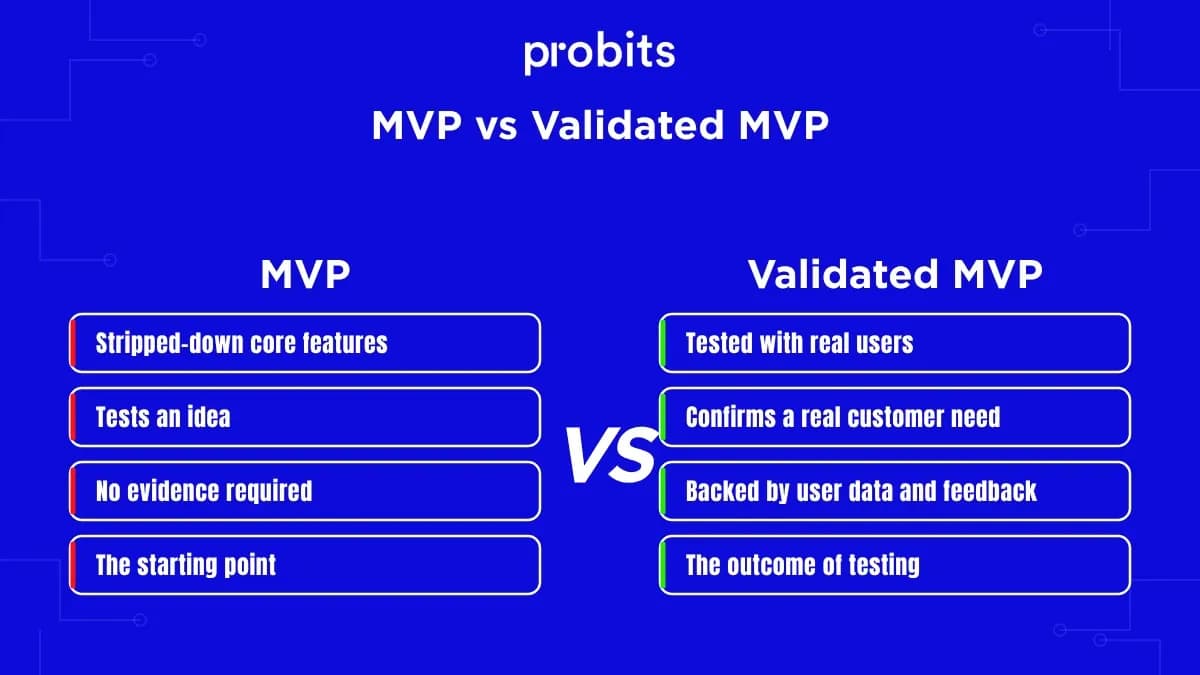
An MVP and a validated MVP are not necessarily the same thing. An MVP is a simplified version of a product containing the core functionality required to test an idea, whereas a validated MVP is an MVP that has been tested with users and supported by evidence showing that the product addresses a real customer need.
For example, imagine a startup wants to create a fitness platform for busy professionals. The startup could spend months building workout plans, nutrition tracking, social features, wearable integrations, and personalised dashboards. Alternatively, it could start with a simple MVP that allows users to receive personalised weekly workout plans, then measure signups, engagement, retention, feedback, and willingness to pay.
If users consistently use the service and report that the personalised plans solve a real problem, the startup has stronger evidence to justify further development. Learning what customers actually need before committing significant resources is the fundamental purpose of MVP validation.
Why Is MVP Validation Important?
MVP validation helps startups test whether their product solves a real customer problem before investing heavily in development. It can help startups:
1. Reduce Development and Financial Risk
Building a complete software product requires significant time, money, and technical resources. Without validation, startups may invest heavily in assumptions that have never been tested. MVP validation helps identify weak assumptions early. If users do not find the product useful, discovering this during the MVP stage is generally less costly than discovering it after a full-scale launch. This follows a simple principle: test before you invest. If cost is a major constraint at this stage, it's worth reading how to approach building your MVP on a limited budget alongside this guide.
2. Understand Customer Needs
Market research, interviews, and surveys can provide useful information, but observing how people interact with a real product can reveal insights that research alone may not uncover. Users may say they want a particular feature but behave differently when they actually use the product. MVP user testing allows startups to compare what customers say with what they actually do.
3. Prioritise Features
Startups often begin with long lists of potential features. MVP testing helps teams identify which capabilities users rely on most and which features can be postponed or removed, keeping the product focused on its core value proposition.
4. Improve Product-Market Fit
An MVP does not guarantee product-market fit, but validation can provide evidence about whether the product is moving in the right direction. Instead of assuming what customers want, startups can continuously collect feedback, analyse user behaviour, and improve the product through multiple iterations.
5. Support Better Investment Decisions
A validated product can provide stakeholders and investors with more useful evidence than an idea alone. Metrics such as user growth, activation, retention, engagement, conversion, and customer feedback can help founders and stakeholders make more informed decisions about whether additional development or investment is justified.
6. Build a More Scalable Business Model
MVP validation can help startups understand whether their business model aligns with customer demand. By learning who uses the product, why they use it, which features create the most value, and what customers may be willing to pay for, startups can build a stronger foundation for future growth. The product and business model may also evolve as the team learns from actual usage—Slack, for example, initially developed as an internal communication tool before evolving into a broader collaboration platform.
How to Validate an MVP
Effective MVP validation should follow a structured process rather than relying on a few positive comments or assumptions.
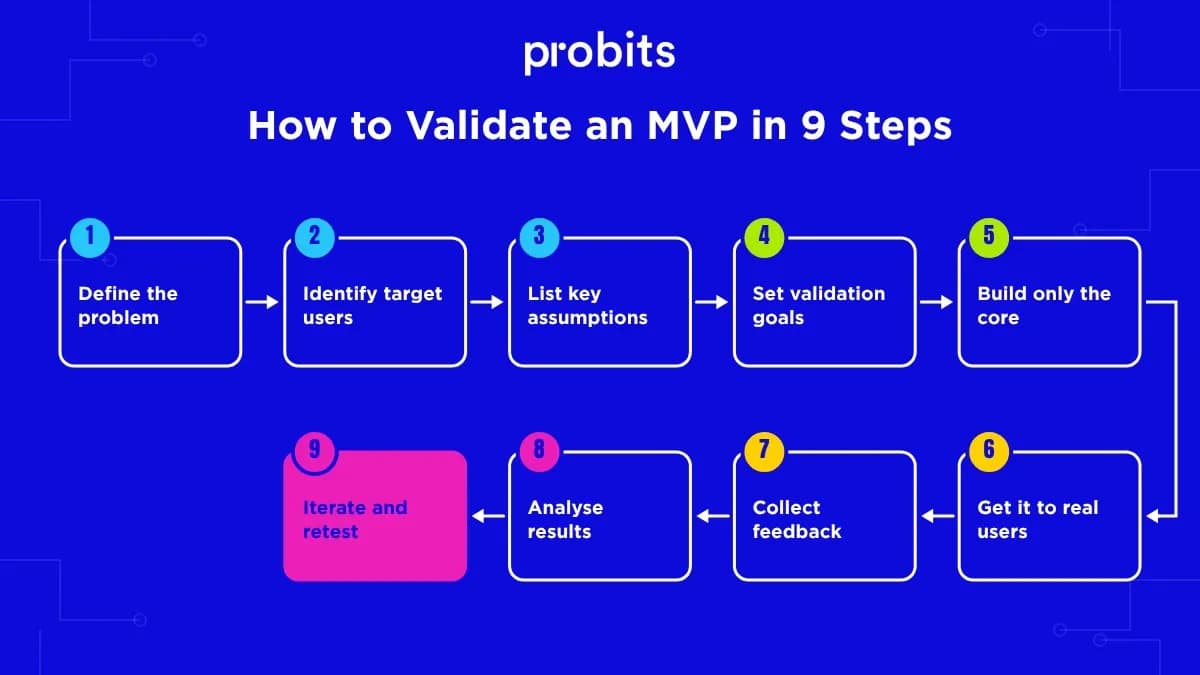
Step 1: Define the Problem
Before testing the product, clearly define the problem you are trying to solve. Ask who experiences this problem, how frequently it occurs, how people are solving it today, what makes existing solutions inadequate, and whether it's important enough for people to seek a better solution. A clear problem statement prevents teams from building technology simply because it is technically possible.
Step 2: Identify Your Target Users
Your MVP does not need to be tested by everyone. Identify the specific group most likely to experience the problem and benefit from the solution — these users can become your early adopters. A narrower audience makes it easier to collect relevant feedback and identify meaningful patterns.
(If you're building without an in-house technical team, it's worth reading about MVP options for non-technical founders before you get to this stage.)
Step 3: Define Your Key Assumptions
Every startup idea contains assumptions — that customers experience the problem, consider it important, that existing solutions are inadequate, that users will adopt a new solution and continue using it, and that customers will pay for it. Write these assumptions down before testing, and design your MVP to test the ones that carry the greatest risk.
Step 4: Establish Clear Validation Goals
Set specific goals before launching your MVP. SMART goals — Specific, Measurable, Achievable, Relevant, and Time-bound — provide a useful framework. Instead of "we want people to like our product", aim for something like "we want to achieve a 20% signup conversion rate from our MVP landing page within 30 days."
Step 5: Build Only What You Need to Test
An MVP should not attempt to become the final product. Focus on the smallest set of features required to deliver the core value proposition for a food delivery startup; that might mean restaurant listings, food selection, order placement, basic payment, and delivery tracking, without loyalty programmes or advanced recommendations. Keeping the product lean also reduces scope creep and makes it easier to understand what is driving user behaviour. Many teams are now using AI-assisted rapid prototyping to build MVPs faster at this stage.
Step 6: Put the MVP in Front of Real Users
Once the MVP is ready, get it into the hands of your target audience through beta testing, landing pages, customer interviews, usability testing, surveys, product demonstrations, early-access programmes, or proof-of-concept testing. If your primary question is whether people are interested in the concept, a landing page or prototype may be sufficient; if you need to understand long-term engagement, people need to use the actual product.
Step 7: Collect Quantitative and Qualitative Feedback
Effective MVP user testing should combine numbers (signups, activation, conversion, DAU/MAU, retention, feature usage, session frequency, trial-to-paid conversion) with direct customer feedback explaining what users like, what frustrates them, what they expected, and why they stopped using the product.
Step 8: Analyse the Results
After collecting feedback, analyse the data to identify patterns — where users drop off, which feature gets disproportionate engagement, whether the price is the sticking point, which segment retains best, and what improvement is repeatedly requested. Funnel analysis and customer segmentation help turn raw data into actionable product decisions.
Step 9: Improve and Iterate
Validation should not end after the first testing cycle. Use the Build → Measure → Learn → Improve → Test Again approach, and let agile practices help the team continuously improve the product as customer needs and market conditions become clearer.
Agile development practices can help teams continuously improve the product as customer needs and market conditions become clearer.
MVP Success Metrics to Track
Choosing the right metrics is an important part of the MVP validation process. The appropriate metrics depend on the product, business model, and validation objective.
- Activation Rate — how many users reach an important milestone after signing up
- User Engagement — sessions per user, feature usage, tasks completed, time spent
- Retention Rate — whether users continue returning to the product
- Conversion Rate — whether users move from free/trial to a paid plan
- Customer Feedback — usability problems, unmet needs, and opportunities a single number can't capture
- Time-to-Value (TTV) — how quickly users experience the primary benefit
- Net Promoter Score (NPS) — how likely customers are to recommend the product, considered alongside behavioural data rather than in isolation
Common MVP Testing Mistakes
Even with a structured process, startups can make mistakes that reduce the value of their validation efforts.
1. Building Too Many Features: One common mistake is turning an MVP into a complete product. Unnecessary features increase development time and make it harder to identify what creates real value. Keep the initial product focused on the core problem.
2. Ignoring Negative Feedback: Negative feedback can reveal important product problems. Instead of dismissing criticism, look for recurring issues and consider whether they point to a larger problem. Constructive feedback can guide better product decisions.
3. Asking Only Friends and Family: Friends and family can provide early feedback, but they may not represent your target market. Whenever possible, test the MVP with people who fit your intended customer profile.
4. Focusing Only on Vanity Metrics: High website traffic or app downloads do not necessarily indicate success. Focus on metrics that reflect meaningful user behaviour. For example, 10,000 downloads with low retention may be less valuable than a smaller group of highly engaged users.
5. Rushing the Validation Process: Validation requires enough time and data. A few positive comments or early signups may not be enough to justify major investment. Define a Minimum Criteria for Success (MCS) before testing to help determine whether the MVP should continue, change, or scale.
6. Poor Communication: Teams and stakeholders should understand what is being tested, what the results mean, and why decisions are being made. Clear communication keeps everyone aligned with the same validation goals.
Risks of Skipping MVP Validation
Skipping validation may appear to save time in the short term, but it can create larger problems later.
- Financial Losses: Startups spend significant resources developing products that customers do not want. Early validation can help identify weak assumptions before they become expensive development commitments.
- Missed Market Opportunities: Without regular validation, businesses may fail to recognise changing customer needs. Competitors that respond more effectively to market demand may gain an advantage by addressing problems that customers consider important.
- Damaged Reputation: A poorly received product launch can negatively affect customer perception. Unvalidated features, poor user experiences, and unmet expectations can result in negative reviews and reduced trust
- Wasted Resources: Without validation, scope creep can lead teams to continuously add features that do not meaningfully improve the product.
This can increase development costs while distracting the team from the core value proposition.
What Can Startups Learn From Google Glass?
Google Glass is often discussed as an example of the challenges of launching an innovative product before establishing broader market acceptance. Google initially introduced Glass through its limited Explorer Programme and later ended consumer sales of the Explorer Edition in 2015, as Reuters reported at the time. The experience highlighted concerns around privacy, design, functionality, pricing, and consumer expectations.
For startups, the key lesson is that technical innovation alone does not guarantee market acceptance. Before scaling a product, businesses need to validate whether customers see real value in it, whether it solves a meaningful problem, and whether the overall experience meets market expectations.
What to Do After MVP Testing
MVP testing should lead to a product decision. There are generally three directions a startup can consider.
- Continue: If the evidence indicates meaningful demand and users are gaining value from the product, the team can continue improving and expanding the MVP.
- Iterate: If users see potential but identify significant problems, the team can modify the product and run another testing cycle. The process can be:
Build → Measure → Learn → Improve → Test Again
- Pivot: If testing shows the original assumption was wrong, change the target audience, value proposition, business model, or product direction before committing more resources.
When Should You Scale an MVP?
Scaling should come after sufficient evidence that the product is solving a meaningful problem for a defined audience. Before increasing development investment, consider whether you have evidence of: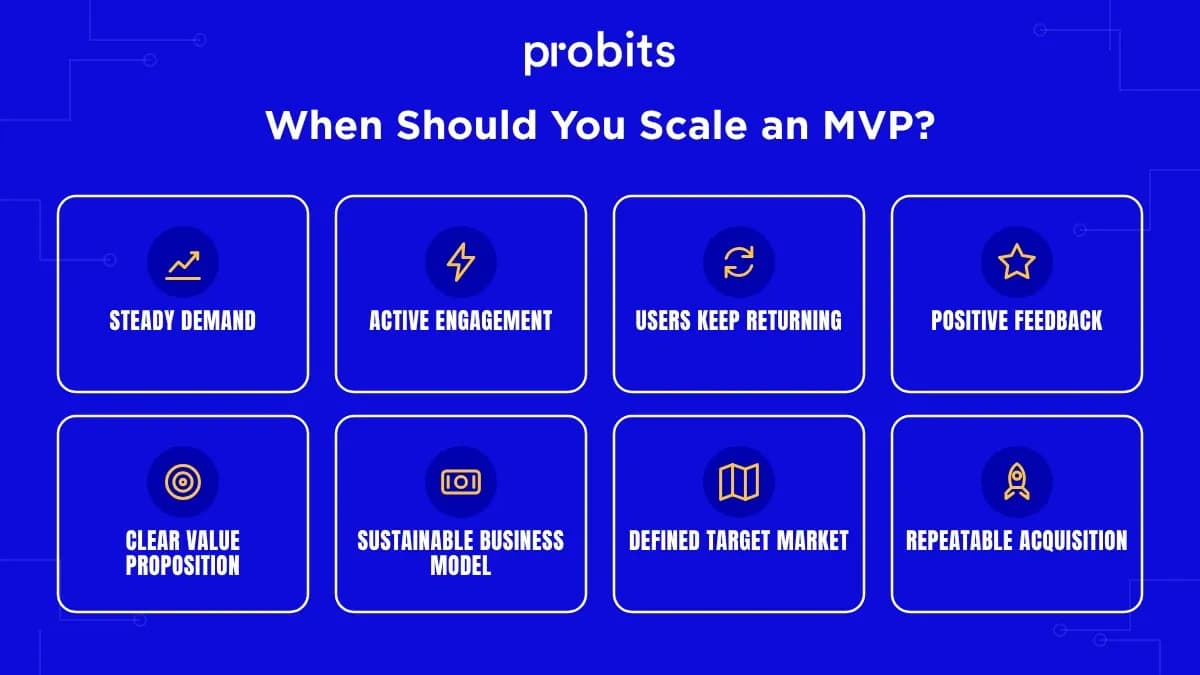
- Consistent user demand
- Meaningful engagement
- Reasonable retention
- Positive customer feedback
- A clear value proposition
- A viable business model
- A defined target market
- Repeatable acquisition channels
There is no universal metric that determines when an MVP is ready to scale. The appropriate threshold depends on the product, industry, target audience, business model, and objectives of the startup. The important principle is to make scaling decisions based on evidence rather than assumptions.
However, MVP validation does not end once a product reaches the point of scaling. MVP testing is an ongoing process. As the product evolves, new assumptions emerge, customer expectations change, competitors introduce new solutions, and market conditions shift.
Startups should therefore continue collecting customer feedback and monitoring user behaviour as they develop and expand the product. The goal is not simply to prove that an idea works but to continuously learn what customers need and use those insights to build a product that creates measurable value.
Frequently Asked Questions
How long should MVP validation take?
There’s no fixed timeline. It depends on what you’re testing and how quickly you can collect meaningful user feedback. A landing page test might take 2–4 weeks, while testing retention or willingness to pay may require 60–90 days of real user data. Set your timeline around clear success criteria rather than a fixed date.
How many users do I need to validate an MVP?
You need enough users to identify consistent patterns rather than a specific number. Interviews and usability testing can reveal major issues with 5–10 target users, while quantitative metrics such as conversion and retention generally require a larger and more representative user group.
What's the difference between an MVP and a prototype?
A prototype is usually a non-functional or partially functional model used to test concepts and usability. An MVP is a working product with the minimum features needed to deliver value to real customers and collect meaningful feedback.
Validate Your MVP with Probits
Building an MVP is only the beginning. The real challenge is turning an idea into a product that customers actually need, use, and value.
A structured MVP validation process helps startups test assumptions, gather real user feedback, measure demand, identify weaknesses, and make informed decisions before investing heavily in development.
This is where Probits can help. From defining the MVP scope and prioritising core features to designing, developing, testing, and improving the product based on user feedback, Probits supports startups throughout the MVP development journey. Our AI MVP development services also help businesses turn AI-powered ideas into practical, testable MVPs.
Instead of building everything at once, Probits helps you focus on the core problem, validate important assumptions, and build based on real market feedback.
Have an idea you want to validate? Probits can help you turn it into a tested MVP and take the next step towards building a product your customers value.**