
From No-Code AI App Builders to Production-Ready Apps: How We Bridge the Gap
 Niresh Lamsal
In the last few months, I've worked with several founders who built their MVPs on no-code AI app builders like Replit, Lovable, and similar platforms. They had something that worked. A live UI, connected data, even basic workflows. But when they tried to onboard real users or scale the app, the cracks started showing.
These tools are fantastic for rapid prototyping, but they rarely deliver production-ready apps out of the box. In this post, I'll walk through exactly how we at Probits turn AI-built prototypes into robust, maintainable, and scalable products you can confidently ship to real users.
What Are No-Code AI App Builders?
No-code AI app builders are platforms that let you create working web or mobile apps using visual tools, AI-assisted code generation, and rapid deployment. You don't need to write much traditional code. Common examples include Replit for AI-assisted full-stack apps, Lovable for AI-generated UIs and backends, and Bolt.new-style builders that assemble components for you.
Common examples in 2026
- Replit-based apps: AI-assisted prototypes, quick demos, and internal tools.
- Lovable-style builders: Great for UI-first applications where the AI generates both frontend and backend logic.
- Other AI-app platforms: Tools that combine drag-and-drop UIs with AI-generated data models and APIs.
Why founders use them
Founders reach for no-code AI app builders because they need to validate an idea fast, launch a demo or beta for investors, or avoid hiring a full-stack team for the first three to six months. These platforms are fast, cheap, and forgiving during the idea-validation phase. That's exactly where they shine.
Why No-Code AI Apps Aren't Production-Ready
When a client hands me a Replit- or Lovable-built app, my first question is always: "Is this ready for real users?" More often than not, the answer is not yet. These tools are built for speed and convenience, not for production-grade reliability, security, and scalability.
1. Weak or missing architecture
Many AI-built apps mix frontend and backend logic in the same environment, lack a clear API layer, and don't define environments for dev, staging, and production. This makes it hard to modify one part of the app without breaking everything else, and even harder to onboard new developers.
2. Security and auth gaps
I've seen hardcoded API keys and secrets in the codebase, no proper authentication or authorization layer, and exposed endpoints with minimal validation. These aren't "nice-to-fix" issues. They're real security risks the moment real users start logging in.
3. Scalability and performance issues
AI-built apps often don't cache frequently used data, run heavy logic on the main request path, and have no observability: no logs, no metrics, no error tracking. This works fine for 10 to 50 users. Under any real traffic, it starts to crumble.
4. Poor maintainability and testing
Many of these apps have no tests, lack documentation or clear code ownership, and are tightly coupled to the platform they were built on. If you ever want to migrate to a different hosting provider or tech stack, refactoring becomes a nightmare.
How We Refactor AI-Built Apps Into Production-Ready Products
When a client comes to us with a no-code AI app builder project, we follow a three-step framework to get it production-ready.
Step 1: Architecture and Code Health Audit
The first thing I do is audit the existing codebase and architecture. I map the data flow between frontend, backend, and database, identify tightly coupled components versus parts that can be decoupled, and decide whether to refactor in place, augment the stack, or rebuild critical parts.
This step answers two critical questions: Can this app realistically scale to 10,000-plus users? Does the current stack align with the product roadmap? The output is a clear "production-ready target" architecture with environment-aware configs and a realistic deployment model.
Step 2: Security, Quality, and Reliability Hardening
Once the architecture is clear, we harden the app. This involves adding proper authentication (OAuth, JWT, or role-based access where needed), moving secrets into environment variables or secure secret managers, and adding input validation, rate limiting, and error handling to every external API endpoint.
On the quality side, we introduce unit and integration tests around core flows (signup, payments, data sync) and fix brittle code patterns. This step turns "it works when I click it" into an app that can survive unexpected input and edge cases.
Step 3: DevOps, Observability, and Scalability
The final layer is DevOps and observability. We move the app from the no-code platform into a proper hosting environment (Vercel, AWS, or a managed Kubernetes cluster), set up staging and production environments with separate configs and databases, and add logging, error tracking via Sentry, and basic performance monitoring.
We also define CI/CD pipelines so new code is automatically tested and deployed, and create a baseline performance budget covering max page load time and API response time targets. At this point, the app behaves like a product you can hand to an operations or growth team with confidence.
Real-World Examples: From No-Code Prototype to Shippable App
Replit MVP to Full-Stack SaaS App
One founder came to us with a Replit-hosted MVP: a simple SaaS dashboard for tracking customer support metrics. The app worked fine during a two-week demo, but started lagging as they added more customers.
We split the Replit monolith into a React frontend and a Node/Express backend, moved the database to a managed PostgreSQL instance, added proper auth and environment-specific configs, and set up CI/CD so every new PR was automatically tested and deployed.
The result was a production-ready SaaS app that scaled to over 400 paying users, while still feeling familiar to the founder who originally built it on Replit.
Lovable-Built Dashboard to Production-Grade Web App
Another client had a customer-facing dashboard built on a Lovable-style builder. The UI looked polished, but the backend logic was opaque and nearly impossible to change without breaking something.
We replaced the auto-generated backend with a clean API layer in Node.js, kept the existing UI as a starting point and gradually upgraded components for better performance and accessibility, and added role-based permissions, audit logs, and monitoring for key API endpoints.
The client ended up with a production-ready web app that still felt like the original Lovable prototype, with much better performance, security, and maintainability underneath.
When to Polish an AI-Built App vs Build From Scratch
One of the most common questions I get: "Should we keep this Replit or Lovable app, or start over?" Here is how I decide.
Keep and upgrade when
- The core flows are simple: CRUD dashboards, internal tools, or narrow-scope MVPs.
- The codebase is small and not too deeply tied to the platform.
- The founder wants to ship fast and iterate with real user feedback.
In these cases, a refactor-and-harden approach is the most cost-effective path.
Recommend a full rebuild when
- The product roadmap includes heavy scale, multi-tenancy, or complex permissions.
- The existing codebase is extremely brittle or tightly coupled to the no-code platform.
- Security or compliance requirements are strict: B2B SaaS, regulated industries, or enterprise clients.
A rebuild lets us design the architecture for long-term growth, not just a fast demo.
What Working With Probits Looks Like
If you're reading this thinking "this sounds exactly like my project," you're not alone. Most founders we work with started on a no-code AI app builder and hit a wall around the time they started onboarding real users.
Here is what we typically deliver:
- Architecture audit: We review your existing Replit, Lovable, or similar project and map out what's working and what needs to change.
- Production-ready refactoring: We refactor the code, add tests, and introduce proper patterns so the app is maintainable and extensible.
- Security and DevOps setup: We add authentication, secrets management, CI/CD pipelines, staging environments, and monitoring.
Frequently Asked Questions
Can I use Replit or Lovable for a production app?
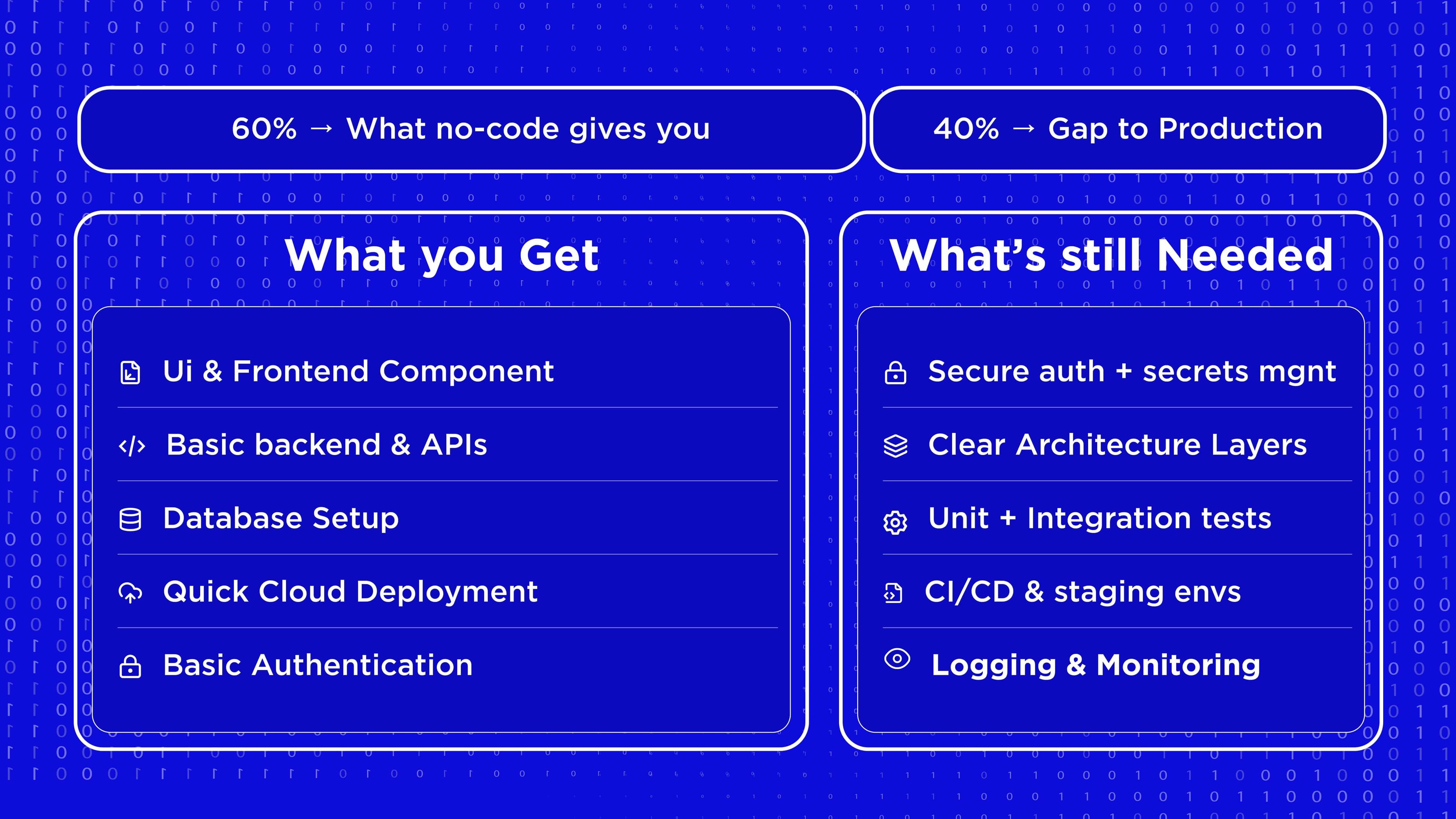
Yes, but not without additional work. These platforms are excellent for MVPs and demos. For production, you'll need to add proper architecture, authentication, security hardening, DevOps setup, and monitoring on top of what the platform gives you. The platform builds the first 60%. Getting to production requires the remaining 40%.
How do I make an AI-built app production-ready?
The core steps are: audit the architecture, harden security (auth, secrets management, input validation), introduce testing, and set up CI/CD with staging and production environments. How much work this takes depends on the complexity of the app and how tightly it's coupled to the no-code platform.
What is the difference between an MVP and a production app?
An MVP is built to test an idea, usually as fast as possible. A production app is built to serve real users at scale, reliably and securely. The gap between them involves architecture, testing, security, observability, and DevOps: things no-code AI builders don't set up for you.
How long does it take to turn a Replit or Lovable app into a production-ready product?
Typical timelines: light polish takes two to four weeks, medium refactoring takes four to eight weeks, and a full rebuild takes two to three months depending on scope. The best way to get an accurate estimate is to share your project and we'll give you a concrete breakdown.
Ready to Take Your Prototype to Production?
No-code AI app builders are a powerful starting point. But they're just that: a starting point. The real value comes when you turn that prototype into something that can scale, handle real users, and grow with your business.