
What is a Fractional CTO? A Guide for Australian Founders
 Apeal Tiwari
A fractional CTO is a senior technology leader who works with your business part-time, usually one to three days a week on a monthly retainer and owns your technical decisions the way a full-time CTO would. In Australia that typically costs A$6,000 to A$25,000 a month. Founders hire one when technical calls keep landing on their desk and nobody qualified owns them.
What does a Fractional CTO do?
A fractional CTO owns your technical decisions part-time. That covers the product and technical roadmap, MVP scope, the stack and architecture, reviewing quotes before you sign, code and QA standards, and security and data risk. Some write code, but most spend their time deciding what gets built, how and by whom, and checking the work.
Picture a non-technical founder six months into a build. On Monday the developers ask which database to use. On Wednesday a second agency sends a quote that's far cheaper than the first. On Friday an investor asks how the app protects customer data. Each of those is a CTO decision, and without a CTO the founder answers them by guessing.
A fractional CTO takes those decisions off your desk. That's the whole fractional CTO meaning: "fractional" describes the hours. The seniority and the responsibility match a full-time CTO's.
The work usually includes:
- Turning the business idea into a product and technical roadmap
- Deciding what belongs in the MVP and what waits
- Choosing the stack, architecture, hosting and third-party tools
- Reviewing quotes, proposals and developer estimates before you sign
- Setting sprint plans, acceptance criteria and QA standards
- Reviewing architecture and code quality
- Managing risk around security, payments, data and integrations
- Making build, buy, rebuild or retire calls
- Getting the product ready for handover, hiring, fundraising or scale
Almost nothing on that list shows up in a demo. That's why founders skip it.
What a week looks like on one day a week
Here's a typical one-day-a-week arrangement. Tuesday morning: the developers' planning meeting, where the CTO pushes back on a feature that would take three sprints and proves nothing. Late morning: an hour reading the week's code changes, looking for shortcuts in payments and permissions. After lunch, a call with you about the agency quote that just arrived. Then a short written note of what was decided and why.
The rest of the week they're on Slack for anything that can't wait. Keep those notes. Six months later, when someone asks why the app runs on this database or that hosting provider, the answer is on file instead of in one person's head.
Fractional CTO vs Full-time CTO, Interim CTO and Consultant
A fractional CTO works part-time and owns technical decisions on an ongoing basis. A full-time CTO does the same job as a permanent employee. An interim CTO works full-time for a fixed period, usually after a CTO leaves. A technical consultant advises on one question and doesn't own the outcome.
| Role | Time commitment | Owns the decisions? | Typical use |
|---|---|---|---|
| Fractional CTO | 1 to 3 days a week, ongoing | Yes, ongoing | Startups and SMEs that need senior technical leadership but not a full-time executive |
| Full-time CTO | Full-time, permanent | Yes | Companies with a large engineering team and constant technical decisions |
| Interim CTO | Full-time, temporary | Yes, for a fixed period | Covering the gap after a CTO leaves |
| Technical consultant | Project-based | No, advisory only | One question, such as an architecture review |
Watch for someone who uses the CTO title but only joins a monthly call. If they never sit in a team meeting, review the work or write their decisions down, you're paying for advice, and nobody owns the outcome.
How much does a fractional CTO cost in Australia?
A fractional CTO in Australia usually costs A$6,000 to A$25,000 a month on retainer. Day rates average about A$1,850, and hourly rates sit around A$150 to A$200. Light advisory work sits at the bottom of that range, and hands-on leadership of a growing team sits at the top.
| Pricing model | Typical Australian range | Best suited to |
|---|---|---|
| Monthly retainer | A$6,000 to A$25,000 a month | Ongoing leadership, the most common setup |
| Day rate | About A$1,850 a day on average | Short projects such as an architecture review |
| Hourly rate | About A$150 to A$200 an hour | A few hours of advice each week |
Sources, checked November 2026: Expert360 (retainers), Fractionus (day rates, based on 10 verified Australian rates), GoFractional (hourly rates).
Rate guides disagree with each other, and most are published by marketplaces that sell fractional executives, so use them as a rough guide. The price you'll actually pay depends on the written scope: days per week, what gets delivered, and what happens outside those days.
A permanent CTO in Australia earns roughly A$200,000 to A$290,000 in base salary (Expert360), before super, payroll tax, recruitment fees and equity. One day a week of fractional leadership at around A$1,900 a day comes to about A$8,000 a month, or under A$100,000 a year. That's less than half a permanent CTO's base salary, before counting super, payroll tax or recruitment fees. At two days a week the fee gets close to that base salary, though the on-costs still don't apply.
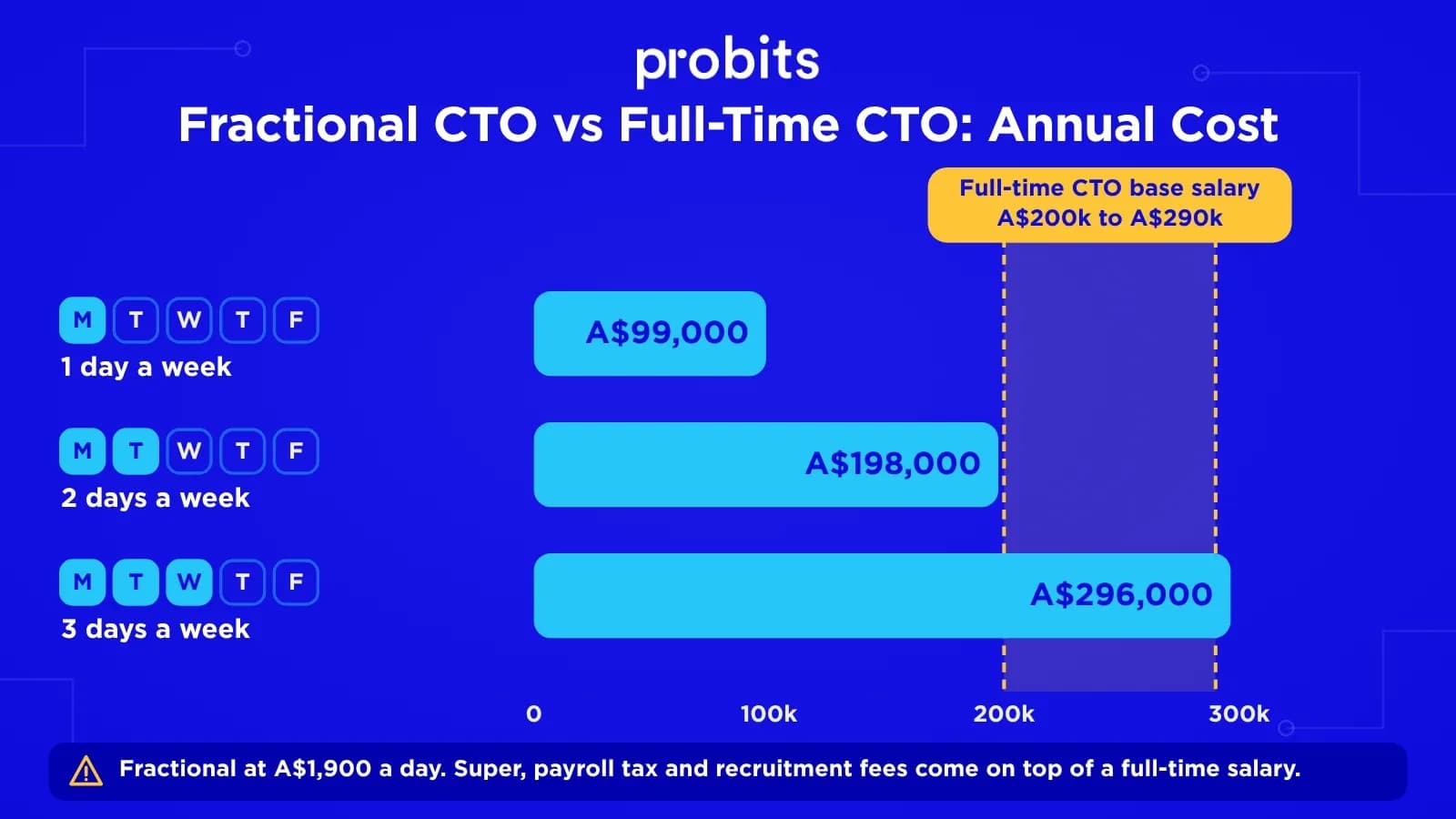
The bigger saving is flexibility. A wrong permanent CTO hire takes months to unwind. A fractional arrangement can grow, shrink or end with the business.
There are also more people doing this work than most founders expect. The Fractional Directory counted 1,015 fractional leaders in Australia in October 2026, and 49% of them are in Sydney (IT Brief). That count covers every C-suite role, so the number of CTOs is smaller, but you should still have several to compare.
What founders get wrong about technical leadership
Most founders who come to us don't think they have a technical leadership problem. They think they have an app that's nearly finished.
- A working prototype feels like a product: A clickable demo or something built over a weekend with an AI tool can look 90% done. Underneath, it may not handle real users, payments, permissions, edge cases, private data or errors. (That last 10% is usually most of the work.)
- Quotes get compared on price instead of scope: A cheaper quote often leaves out discovery, QA, deployment, third-party integrations or ongoing support. You find out what was missing after you've signed. This guide to the software discovery phase covers what a quote should be built on.
- The founder becomes the architect by default: When nobody owns technical decisions, the founder ends up as product owner, architect, QA tester and decision-maker at once, usually without the context to make those calls with any confidence.
- Handover risk stays invisible until you need to switch teams: Undocumented code and access spread across old accounts make changing developers slow and expensive. Check early that you own the source code and hold the admin logins.
- "Add AI" gets treated as a feature: In practice it's a set of decisions about data, accuracy, privacy, human review, cost per use and what happens when the model gets it wrong.
- Architecture gets pushed to "later": That's fine for a throwaway prototype, and a problem for a product that needs to onboard users, take payments and grow.
A real example: Two to Three years without a launch
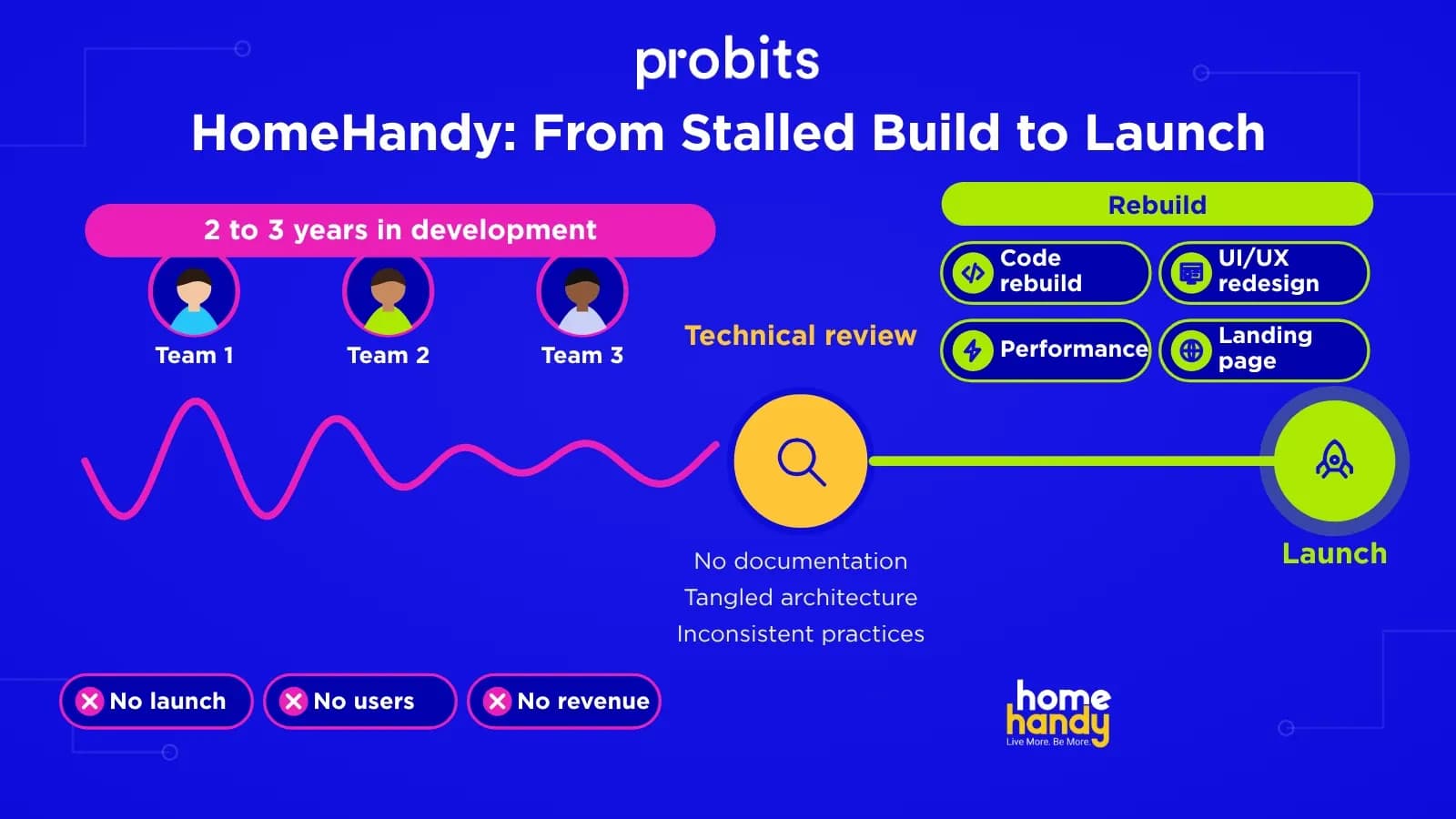
HomeHandy is a home-services platform that connects homeowners with service professionals. It handles bookings, Stripe payments, digital ID verification, scheduling and business-management tools for the professionals.
When Probits got involved, the platform had been in development for two to three years. Several developers had worked on it. It still hadn't launched.
We were asked for a small scope change and we expected to treat it as one. The technical review changed that plan. The codebase had inconsistent practices, no documentation and a tangled architecture, so every change was slow and likely to break something else. The small change turned into a full codebase rebuild, a UI/UX redesign, performance work and a new landing page.
The rebuild was the visible cost. The larger one was two to three years in which the founder couldn't launch, couldn't sign up users, couldn't test whether the marketplace worked and couldn't earn revenue from it.
We don't think the earlier developers were simply bad. Each team made its decisions in isolation because nobody owned the architecture from one team to the next. One accountable technical leader, even part-time could have assessed the codebase, controlled scope and made the build-or-rebuild call years earlier.
When to Hire a Fractional CTO
The clearest signal is an ownership gap: technical decisions keep reaching the founder, and nobody senior is accountable for them. If two or more of these are true, it's worth talking to one:
- You're a non-technical founder about to hire your first developers or sign with an agency.
- You have a prototype or minimum viable product and need to decide what to keep, fix or rebuild.
- You're preparing to raise money and expect investors to check the code, architecture and security.
- Your developers are shipping, but you can't tell whether the work is good or built to scale.
- Cloud bills, bugs or outages are growing faster than your user numbers.
- Your CTO has left and you need leadership while you find a replacement.
If you're still weighing up MVP options for non-technical founders, a fractional CTO is often the missing step between having the idea and briefing a team to build it.
Do I need a fractional CTO yet?
You probably don't need a fractional CTO yet if someone senior already owns your technical decisions, or if a wrong technical call wouldn't cost you much. That usually means one of these:
- You already have a capable technical co-founder or in-house CTO.
- You're building a brochure website, a basic landing page or a low-risk internal tool.
- You only need occasional freelance work, and you can judge scope and quality yourself.
- You have an experienced engineering lead who needs extra hands, not direction.
- You're still testing whether anyone wants the product. Customer interviews and a no-code prototype will teach you more for less.
The more useful question is whether anyone is accountable for sound technical decisions as the product grows. If the honest answer is no, that gap needs filling, by a fractional CTO, a co-founder or a development partner that takes real technical ownership.
Fractional CTOs and AI-built MVPs
In 2026, AI coding tools let a founder build a working app over a weekend. A lot of fractional CTO work now starts with an app like that: it exists, it demos well, and it was never built for real users, real data or real payments.
The usual problems sit where a demo never looks. API keys end up in the front-end code, where anyone can read them. A logged-in user can open every other user's records. There are no automated tests, so each fix breaks something two screens away, and the database that was quick with 20 test accounts crawls at 2,000.
A fractional CTO audits the app, decides what's worth keeping and sets the order of fixes before more code gets written. AI changed how MVPs get built, but a product still needs security, sound architecture and someone accountable for both.
The first thing I do is generate a diagram of the application's core components and how they connect. It shows me what problem the app is actually trying to solve, and whether the way it has been built supports that, before I look at the code in detail. – CTO of Probits
Fractional CTO for Startups, SaaS companies and Small businesses
The case for a fractional CTO changes with the type of business. What stays the same is the need for one senior person who owns technical decisions without the cost of a full-time executive.
Startups building an MVP
A fractional CTO for startups at the MVP development stage usually focuses on scope, architecture and choosing who builds the product. That often means cutting the feature list to what proves the idea, picking a stack the team can maintain and making sure the founder owns the code.
SaaS startups
Fractional CTO services for SaaS startups lean towards multi-tenant architecture, subscription billing, uptime and data security. These are the areas where early shortcuts become expensive once paying customers depend on the product.
Small businesses
A fractional CTO for a small business is often less about building a new product and more about choosing systems, managing IT vendors, moving to the cloud and replacing spreadsheets with custom tools. Sometimes the job is deciding whether an ageing system should be modernised or replaced. One or two days a month can be enough.
How to hire a Fractional CTO
Before you hire a fractional CTO, compare fractional CTO services on more than price. Look for:
- Someone who explains trade-offs in plain English. If they can't do it without jargon, you'll struggle to make decisions with them.
- Experience at your stage. Someone who ran a 200-person engineering team may be the wrong fit for a three-person startup, and the reverse is also true.
- The ability to read code and spot problems themselves.
- A written scope and an exit plan. Agree on days per week, response times and deliverables up front, and expect documentation a future CTO could pick up.
Ask for one past client you can call. Then ask that client a single question: what did this person decide that you couldn't have decided yourself?
What to put in the agreement
A short agreement saves arguments later. Before the first invoice, agree on:
- Days per week, which days, and how fast they reply between them.
- The term and notice period. A three-month initial term is common, because the first month is mostly spent learning your product. After that, 30 days' notice on either side is typical.
- Code and IP. Everything they produce belongs to your company. Repositories, cloud accounts and domains sit in accounts you control, with the CTO added as a user.
- Conflicts of interest. Most fractional CTOs work with two to four clients at once, so ask them to confirm none of those competes with you.
- What they leave behind if the arrangement ends: architecture notes, a decision log and access lists.
A fractional CTO works best when they're in at least one weekly meeting with the developers, not just with you. That matters even more with outsourced teams. If you're deciding between offshoring and outsourcing, a senior technical person on your side makes either model much safer.
Most fractional CTOs work remotely, so founders in Sydney, Melbourne, Brisbane or Perth aren't limited to local options. Time zone overlap matters more than postcode.
What happens in the first 90 days
In the first 90 days, a fractional CTO should audit your code, contracts and accounts, agree a short roadmap with you, and get the team running on regular planning and reporting. The usual order:
- Weeks 1 to 4: The CTO reads the code, the contracts, the cloud bill and the backlog before changing anything, moves admin access to accounts you own and talks to each developer one on one. At the end of the month you should get a written assessment of what's sound, what's risky and what to stop doing now.
- Weeks 5 to 8: You agree a short roadmap together. Features that don't serve the next milestone get cut or delayed, and basic QA, code review and deployment habits go in if they're missing.
- Weeks 9 to 12: The team runs on sprint planning, a decision log and monthly reporting to you or your board. By day 90 you should be able to answer an investor's technical questions without forwarding them.
If you're three months in and still don't have that first written assessment, raise it. That's the clearest early sign the arrangement isn't working.
What a Fractional CTO can't do
A fractional CTO has three main limits. They aren't on hand every day when something breaks, they can't run a large multi-team engineering group for long, and they can't stand in for a build budget.
The first shows up on the bad day. If production goes down on a Thursday and their day is Tuesday, you need an on-call developer or an agency support plan as well.
The second is team size. Once you have several developers in more than one team, someone needs to run them full-time: hiring, one-on-ones, performance, the daily mess. A fractional CTO can set that structure up and help hire the person who runs it, but holding it together at two days a week gets hard.
The third is money. A technical plan does nothing until someone builds it, so if cash is tight, spend it on the build and get a fixed-scope review instead of an ongoing retainer.
CTO-level decisions without hiring a CTO
You don't always need to hire a separate fractional CTO. Some development partners can cover those decisions as part of the build, as long as someone senior owns them.
That's how we work at Probits. Our CTO, Apeal Tiwari, leads a team of senior developers, QA, UI/UX and project managers. For founders without a technical co-founder, we cover architecture and stack decisions, review existing codebases and recommend whether to extend, refactor or rebuild, and break quotes into milestones so you know what's included. We also own code and QA standards, security and reliability, and whether an AI feature is actually worth building.
What a founder gets is someone who can tell them plainly what to build next, what it should cost, what could go wrong and how to protect the product as it grows. If that's what you need for your MVP development, book a free consultation and we'll review where your product stands. If budget is the first question, our guide to MVP development cost sets out what to expect.
Frequently Asked Questions
What is a fractional CTO?
A fractional CTO is an experienced chief technology officer who works with a company part-time, usually one to three days a week on a monthly retainer. They own the company's technical strategy, team and decisions, at a lower cost and time commitment than a full-time executive.
What does fractional CTO mean?
Fractional CTO means a chief technology officer who works for a fraction of the week rather than full-time. The word "fractional" describes the time commitment. The seniority and responsibility stay the same as a full-time CTO's.
How much does a fractional CTO cost in Australia?
Most fractional CTO engagements in Australia cost A$6,000 to A$25,000 a month, depending on days per week and scope. Day rates average around A$1,850, and hourly rates typically sit between A$150 and A$200.
How long does a fractional CTO engagement last?
Most start with a three-month initial term, then run month to month with around 30 days' notice. Some last a year or more. Others end once the company hires a full-time CTO, often one the fractional CTO helped recruit.
When should a startup hire a fractional CTO?
A startup should consider a fractional CTO when important technical decisions are being made without a qualified, accountable person in charge. Common moments are hiring the first developers, preparing an MVP for launch, fixing an AI-built prototype and getting ready for investor due diligence.
What is the difference between a fractional CTO and a technical consultant?
A technical consultant gives advice on a specific question and then leaves. A fractional CTO takes ongoing responsibility for technical outcomes, joins team meetings, reviews work and is accountable for decisions over time.
Can a fractional CTO fix a vibe-coded or AI-built app?
Yes. Reviewing AI-built apps is now one of the most common reasons founders hire a fractional CTO. They audit the code for security and scaling problems, decide what to keep or rebuild, and set the order of fixes before the app reaches real users.
Can a development company act as your fractional CTO?
Yes, if the company has a senior technical leader who owns architecture, scope and quality decisions for your product. Check who makes those decisions, how they're documented and whether you keep full ownership of the code.
Does a fractional CTO write code?
Some do, but most spend their time on strategy, architecture, code reviews and team leadership. If you mainly need more building capacity, a senior developer or development team is usually the better fit.
Is a fractional CTO worth it for an early-stage startup?
Before the idea is validated, a fractional CTO is usually premature. Once you're building or launching a real product without technical leadership, the cost of one is often far lower than the cost of rebuilding a product that was built the wrong way.