
Rapid Prototyping with AI: A Framework to Validate Ideas and Reduce Product Risk
 Probits
Every successful product begins with a sense of uncertainty. When a team sits down to build something new, they are usually armed with a collection of ideas, assumptions, and best guesses about what their users truly want and what the market will ultimately accept. This is a vulnerable stage of the creative process. The challenge most teams face is not that their ideas are inherently weak, but rather that the process of validating those ideas often takes far too long. In the time it takes to build a prototype and get it into the hands of users, the market may have already shifted.
To address this, rapid prototyping emerged as a vital practice. It allows teams to test their ideas early, before they have invested significant time and resources into full scale development. Today, we are seeing a fundamental shift in this landscape. Artificial intelligence is no longer just a futuristic concept; it is actively changing how teams learn, decide, and adapt throughout the entire product development lifecycle. AI is not merely making the process faster, it is changing the very nature of how we approach problem solving.
Understanding the Heart of Rapid Prototyping
At its core, rapid prototyping is about turning abstract thoughts into something tangible. Whether it is a wireframe, a mockup, a clickable demo, or a functional proof of concept, the goal is to create a version of the product that can be tested against reality. There is a common misconception that a prototype needs to be perfect. In fact, the goal of rapid prototyping is never perfection: its goal is validation.
Instead of waiting months to see if an idea works, teams use these models to test assumptions within days or weeks. This shift is essential because modern markets evolve much faster than traditional roadmaps. User expectations shift faster than release cycles, and competitors are often experimenting at a pace that traditional planning cannot match. In this high pressure environment, speed equals optionality. When you can move quickly, you gain the power to pivot when necessary, the option to kill weak ideas before they become expensive failures, and the ability to double down on the features that are actually resonating with your audience.
How AI Compresses the Learning Loop
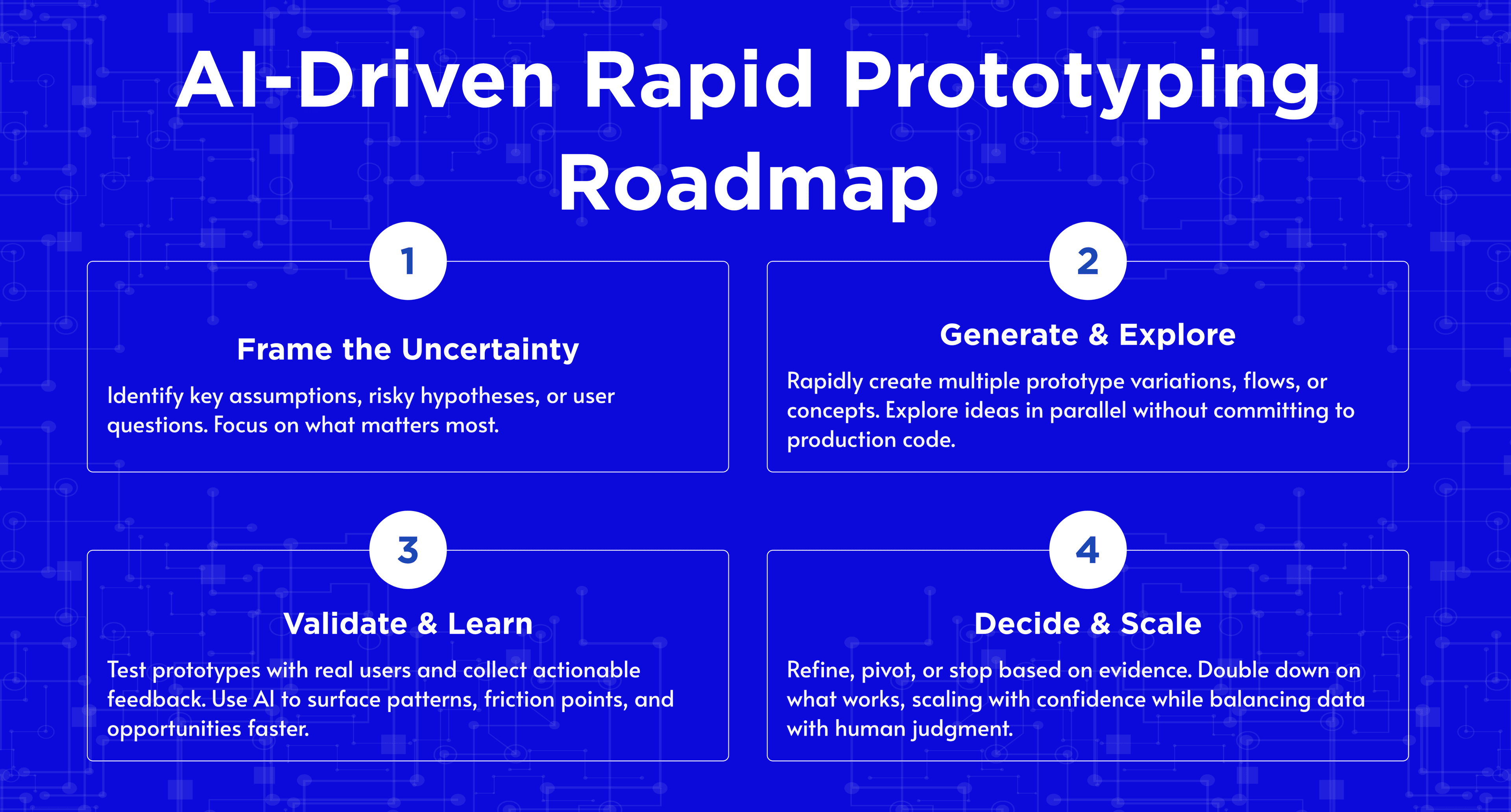
AI does not replace the human element of prototyping; instead, it compresses the learning loop. By automating parts of the creation, analysis, and iteration phases, AI transforms prototyping into a continuous feedback engine rather than a one-time design exercise. This means that instead of a linear path of building and then testing, the process becomes a fluid, ongoing conversation between the product and the data.
AI-powered rapid prototyping works by integrating intelligence directly into the creation and refinement of these early versions. Rather than relying solely on manual design work, teams can use AI to generate multiple variations of a concept, analyze how users might interact with them, and even predict potential outcomes before a single user has even touched the interface.
The primary difference between traditional methods and AI-driven methods lies in how decisions are informed. Traditional prototyping depends heavily on human intuition and small sample sizes. While human intuition is powerful, it can be limited by bias or a lack of data. AI introduces pattern recognition and data-driven insights, helping teams identify what is likely to work before they commit significant resources. By using technologies like machine learning, generative AI, natural language processing (NLP), and computer vision, prototypes stop being static iterations. They become learning systems that evolve and improve with every single test they undergo.
The Core Benefits: Beyond Just Speed
One of the most visible benefits of AI is undoubtedly the speed of iteration. AI allows a team to explore multiple design directions simultaneously, which dramatically shortens the time it takes to get meaningful feedback. But the benefits go much deeper than just the clock.
Cost reduction is a natural byproduct of this efficiency. When you can validate an idea early, you avoid the painful experience of investing months of work into features that users simply do not want. AI helps surface these issues long before they ever reach production, saving an incredible amount of time, money, and development effort.
Furthermore, AI can actually make products more user-centric. By analyzing real behavior rather than relying on the team's assumptions, AI provides a clearer picture of how people actually interact with a tool. This leads to designs that are more intuitive because they are aligned with real human needs rather than a designer's preference.
Finally, there is the benefit of decision quality. We have all been in meetings where opinions clash and it is hard to find a way forward. When insights replace opinions, teams can move forward with much more confidence. AI supports evidence-based decisions, which reduces internal friction and improves alignment across all stakeholders.
Real-World Impact: From Startups to Enterprise
We can see these benefits playing out in different types of organizations. For a startup, AI might be used to validate a new SaaS concept. They might use AI to convert a rough idea into a series of clickable prototypes, testing different onboarding flows and analyzing how early users interact with the interface. The result is that they can validate market demand before they have even written a single line of production code, which can save a small company months of effort.
In an enterprise setting, the scale is different but the value is the same. Large teams can integrate AI into their prototyping workflow to run parallel design experiments at a massive scale. They can use AI to predict usability issues and optimize which features should be prioritized based on data. This leads to faster releases, fewer rollbacks, and a much stronger alignment between the business goals and the engineering team's output.
Navigating the Challenges with Care
Despite all these advantages, it is important to remember that AI is not a magic solution. It has real limitations that require a human touch to navigate. For one, the quality of any AI insight is entirely dependent on the quality of the data it receives. If you feed the system poor data, you will get misleading conclusions.
There is also a significant risk of over-reliance. While AI can suggest patterns and find correlations, it does not understand context, it does not feel emotion, and it cannot grasp a long-term business strategy. Human judgment is, and will remain, essential to the process.
Creativity is another concern. While AI is excellent at recognizing and repeating patterns, breakthrough ideas often come from human intuition and unconventional thinking. If we rely too much on AI, we risk unintentionally reinforcing existing norms rather than creating something truly new. We must also be mindful of the ethical side of things, as using AI tools deeply within a workflow brings up important questions about data privacy, intellectual property, and transparency.
Best Practices for a Humane Approach
If you want to bring AI into your prototyping process, the most effective way is to treat it as an assistant rather than a replacement. Start with a very clear definition of the problem you are trying to solve. AI performs at its best when it is guided by focused, human-defined objectives.
Most importantly, you must continue to validate AI-generated insights with real users. AI predictions are valuable, but direct feedback is the only way to truly ensure that what you are building is relevant and trustworthy. The strongest outcomes happen when you find a balance between the speed of technology and the depth of human insight.
Conclusion: Amplifying the Human Element
AI is undeniably reshaping the world of rapid prototyping by making it more data-driven and more adaptable. However, the future of product development will not be defined by the teams that use AI for everything. Instead, it will be defined by the teams that use it intentionally, applying it where it can add clarity, reduce uncertainty, and help us learn faster.
At the end of the day, AI does not replace the need for good product thinking. It amplifies it. It takes the seeds of our ideas and helps us grow them into something tangible, helping us navigate the uncertainty of creation with a little more confidence and a lot more insight.
Further Reading: From Strategy to Execution
If this article helped you understand where AI adds leverage in rapid prototyping, the next logical step is seeing how that strategy plays out in practice.
In our follow-up piece, we break down how teams can move from an idea to a validated MVP in just one week using AI-assisted workflows without cutting corners on learning or quality.