
AI Rapid Prototyping: How to Build an MVP in 7 Days
 Probits
In the hypercompetitive world of technology startups, speed is everything. The difference between a breakthrough product and another fleeting idea is often how quickly founders can move from concept to code and ultimately to customer validation. Rapid prototyping with artificial intelligence is the new gold standard for startups and product teams looking to stay ahead. Instead of weeks or months spent designing, building, and testing, AI powered prototyping enables founders to launch, learn, and iterate in record time.
AI rapid prototyping is the process of using artificial intelligence, no-code tools, and automation to design, build, and test a minimum viable product in days instead of months. For startups, especially in Australia’s competitive tech ecosystem, AI-powered prototyping enables faster validation, lower development costs, and quicker paths to market.
Whether you're building your first app, dreaming up the next big SaaS platform, or looking to disrupt established markets, this guide explains how leading Australian startups go from idea to interactive demo in just seven days.
Related Read: How to Launch a Software Product in 30 Days
What Is AI Rapid Prototyping?
Unlike traditional rapid prototyping, AI rapid prototyping uses generative AI, automation, and low-code platforms to accelerate MVP development and early decision-making. Rapid prototyping refers to techniques for building functional mockups of a product quickly, often within days or even hours.
Instead of developing every feature for production, the goal is to create a usable version that demonstrates core value, validates assumptions, and enables real world testing. This approach significantly reduces risk before full-scale development.
Startups often combine rapid prototyping with structured MVP validation to ensure there is real demand before scaling.
Today’s AI rapid prototyping process leverages:
No code and low code platforms: Tools that empower non-technical founders to build visually and functionally rich products without heavy engineering effort.
Generative AI: Models that help design, code, test, and optimise product components more intelligently.
Automation frameworks: Services that automate testing, deployment, and analytics to shorten feedback loops.
Why AI Changes the Game for Prototyping
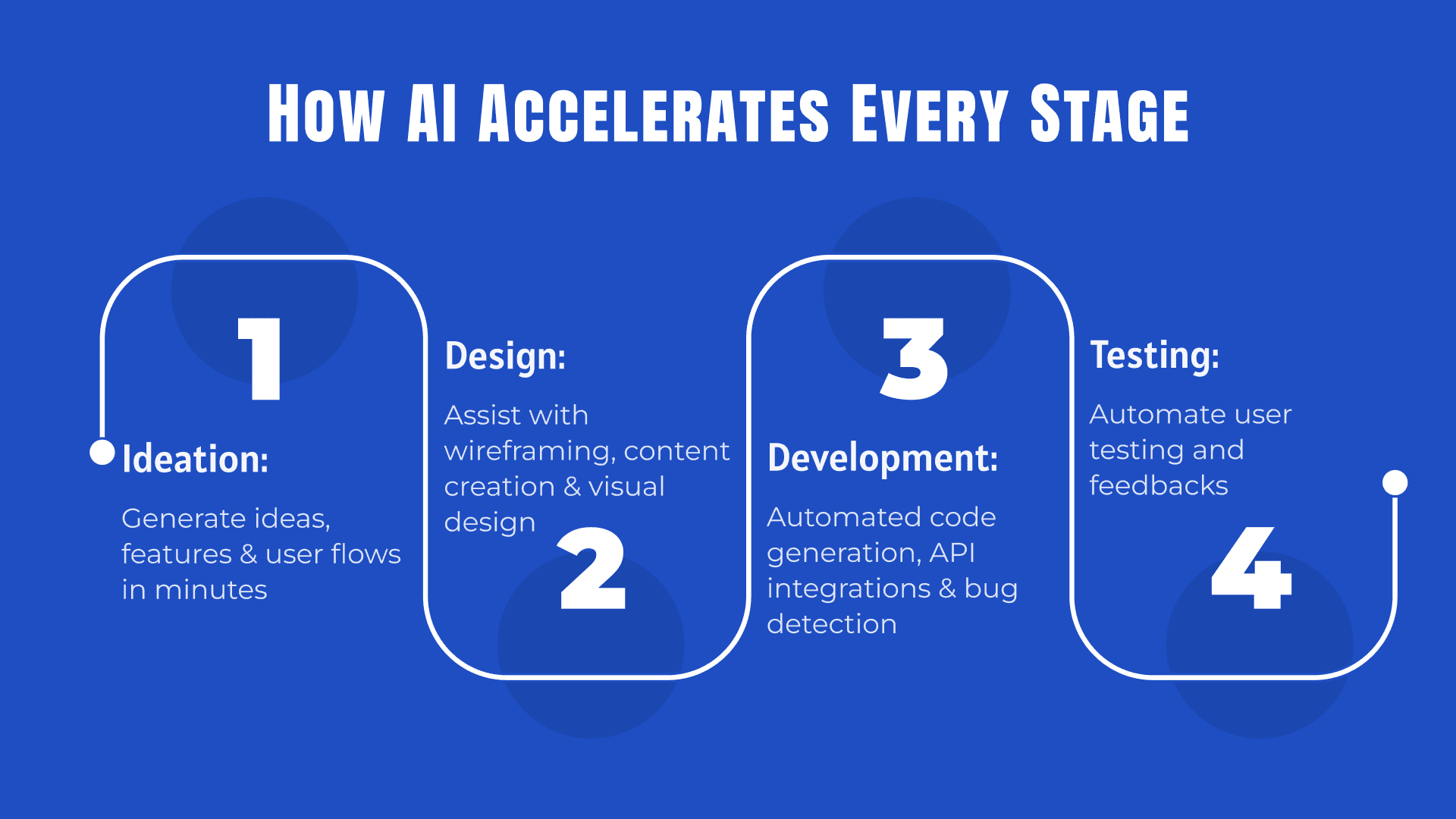
Artificial intelligence has dramatically accelerated each stage of the prototyping lifecycle when supported by the right AI startup tech stack.
Ideation: AI powered tools like ChatGPT, Gemini, and Claude generate ideas, features, and user flows in minutes.
Design: Generative AI assists in wireframing, content creation, and visual design, ensuring prototypes look polished and user-friendly.
Development: Automated code generation, API integrations, and bug detection streamline turning designs into working demos.
Testing: AI automates user testing, gathers feedback, and highlights usability issues through behavioural analytics.
Adopting AI for rapid prototyping is not just a time saver. It creates a competitive advantage that separates fast moving startups from those stuck in traditional development cycles.
Related Read: AI Agents in Software Development: How Startups Scale Faster at Lower Cost
The 7 Day Roadmap to an Interactive Demo
Day 1: Pinpoint the Problem and Define the User
Great products start with real problems. Begin by mapping your intended user and the pain points you are trying to solve. Use AI ideation tools to generate:
- Problem statements that clearly articulate user challenges
- User personas with demographic and behavioural insights
- Potential solution features ranked by impact
Validate assumptions early using surveys, interviews, or lightweight market research. This ensures you are building something people actually need.
Day 2: Ideation and Feature Planning
Move from broad ideas to actionable flows. Work with AI tools to:
- Identify must-have features for your MVP
- Sketch user journeys, screens, and decision paths
- Prioritise features based on effort versus impact
AI-powered planning platforms help founders make faster, data-backed decisions without overthinking early-stage scope.
Day 3: Select Tools and Build a Tech Foundation
You do not need to write code from scratch. For AI rapid prototyping, select platforms such as:
Figma for interface design and collaboration Bubble for no-code web applications Vercel for fast deployment Voiceflow for conversational experiences OpenAI APIs and Gemini for intelligent features
Many Australian startups combine these tools with offshore development teams to maintain speed while keeping costs under control.
Day 4: Wireframe and Design with AI Assistance
Use generative design tools to create interactive wireframes quickly. AI helps generate UI layouts, sample copy, and micro-interactions, allowing teams to test multiple design approaches without heavy design effort.
Day 5: Develop and Integrate Core Features
Integrate must-have features and showcase your product’s differentiators:
- AI chatbots, recommendations, or search functionality
- Synthetic datasets to simulate real user behaviour
- Low-code integrations to connect APIs and workflows
Synthetic data enables realistic demos without waiting for real users.
Day 6: Test, Measure, and Iterate Rapidly
Deploy your prototype to a small user group. AI-powered analytics and testing tools identify bugs, friction points, and engagement gaps automatically, helping teams iterate quickly.
Day 7: Present and Plan Next Steps
With a working interactive demo, present to beta users, investors, or internal stakeholders. Use feedback to guide the next phase, whether that is fundraising, production development, or market launch.
Common Mistakes in AI Powered Prototyping
Even with AI assistance, certain pitfalls can slow progress:
Overengineering: MVPs should validate ideas, not replicate full products.
Ignoring early feedback: Human feedback reveals insights that AI alone cannot predict.
Forgotten SEO: Early discoverability helps validate demand sooner.
Tool paralysis: Spending too long evaluating tools undermines rapid execution.
Related Read: How to Build an MVP on a Budget: Step-by-Step Startup Guide
Integrating Prototyping with Your Overall Product Strategy
Rapid prototyping impacts more than product launches.
It strengthens fundraising by enabling interactive demos, improves employer branding by showcasing execution speed, and accelerates go-to-market validation.
Many founders pair rapid prototyping with offshore teams. Understanding offshoring vs outsourcing helps Australian startups choose the right long-term model.
Frequently Asked Questions (FAQs)
1. What is AI rapid prototyping?
AI rapid prototyping is the process of using artificial intelligence, no-code or low-code tools, and automation to quickly design, build, and test a minimum viable product (MVP). It allows startups to validate ideas and launch interactive demos in days instead of months.
2. How long does it take to build an MVP using AI?
With the right AI tools and workflows, startups can build a functional MVP or interactive demo in as little as 5 to 7 days. This includes ideation, design, development, testing, and early user feedback.
3. What are the best AI tools for rapid prototyping?
Popular tools include ChatGPT and Gemini for ideation, Figma and Figma AI for design, Bubble for no-code development, Vercel for deployment, and OpenAI APIs for intelligent features like chatbots and recommendations.
4. Is AI rapid prototyping suitable for non-technical founders?
Yes. AI-powered no-code and low-code platforms are specifically designed to help non-technical founders build and test product ideas without writing complex code, making rapid prototyping accessible to everyone.
5. How does AI rapid prototyping reduce startup costs?
AI reduces development time, minimizes engineering hours, automates testing, and eliminates unnecessary features early. This lowers overall MVP costs and prevents startups from investing heavily before validating product-market fit.
6. Can AI rapid prototyping be used for investor demos?
Absolutely. Interactive demos built with AI are highly effective for investor pitches because they demonstrate real product value, user flows, and market potential better than static slide decks.
7. Why is AI rapid prototyping popular among Australian startups?
Australian startups use AI rapid prototyping to compete globally with lean teams, control development costs, and accelerate go-to-market timelines in a highly competitive tech ecosystem.
Conclusion: The Future of Prototyping in Australian Tech
AI powered prototyping is transforming how founders and product teams build software. By following a structured seven day roadmap, startups can validate ideas faster, reduce risk, and iterate with confidence.
The startups that master AI rapid prototyping do not just move faster. They build better products by testing more ideas, learning earlier, and adapting continuously.
Ready to build, test, and iterate in a week? Contact Probits to discover how AI powered prototyping can accelerate your product development journey.