
How to Launch a Software Product in 30 Days
 Probits
Startups rarely fail because of bad ideas or small teams. They fail because they spend too long trying to build the perfect product before testing it in the real world. In today’s rapidly shifting SaaS and software markets, a 12-month development cycle is an expensive gamble for any startup. By the time the product is ready, user preferences may have moved on, new competitors may have emerged, and the capital may have already run out.
The Quick-Ship Strategy is a framework for launching functional MVP products within 30 days, using real customer feedback to guide every next step. Instead of betting everything on assumptions, founders learn directly from users, save capital, and position themselves to adapt faster than competitors.
Here's what's actually occurring while you refine your solution in isolation:
- Market preferences are evolving at breakneck speed (consider TikTok's disruption of Instagram)
- Fresh competitors are launching with streamlined, agile alternatives
- Financial landscapes are influencing customer purchasing behaviors
- Your meticulously designed features may address outdated challenges
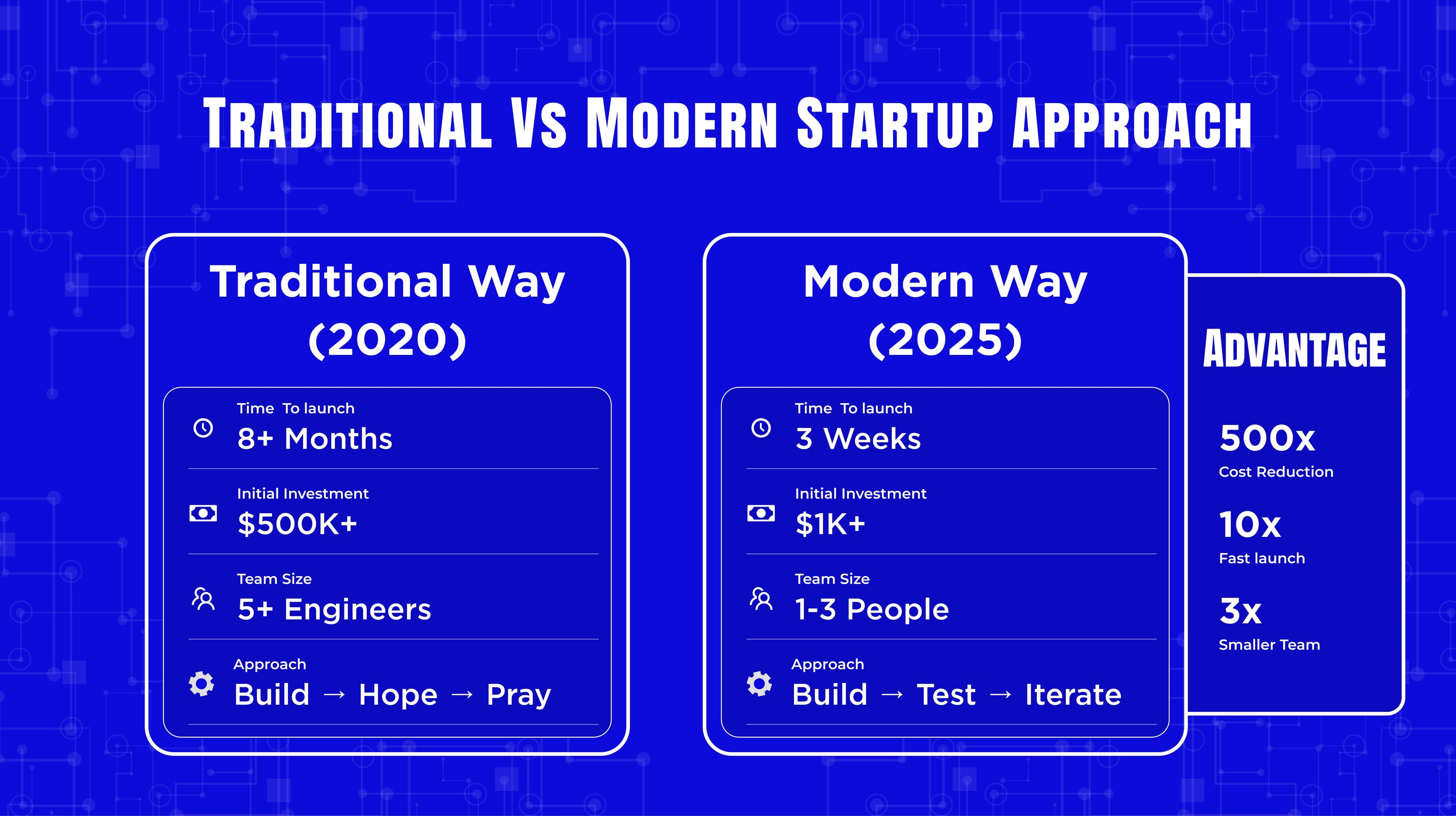
The Quick-Ship Strategy completely reverses this approach. Rather than developing blindly and hoping for market acceptance, you deploy a functional product within 30 days and allow genuine users to direct your development priorities. This isn't about compromising quality, it's about cutting through assumptions to identify what truly resonates with your customers. This approach aligns with modern AI rapid prototyping methods used in successful MVP software development to accelerate time-to-market.
Why Year-Long Development Destroys Startups
Traditional "develop first, release later" methodologies create multiple cascading failure points that frequently prove lethal. Recognizing these dangers is essential for any entrepreneur considering prolonged development timelines in SaaS, FinTech, health tech, or consumer apps.
The Financial Destruction Cycle
Prolonged development creates a monetary catastrophe that destroys even well-capitalized startups. Consider the monthly financial drain occurring before generating any revenue:
This financial strain generates a destructive pattern where entrepreneurs require capital to maintain development, yet investors increasingly demand evidence of user engagement and market validation before investing. Without a released product, you can only provide forecasts and industry analysis, which carry substantially less impact than genuine user metrics and income data.
Market Transformation Exceeds Development Speed
The rate of market evolution has intensified dramatically in our digital era. Revolutionary concepts in January may seem antiquated by December. Extended development cycles increase the probability that your assumptions about customer needs and market dynamics become irrelevant.
Examples of rapid market changes:
- TikTok revolutionized Instagram's user engagement approach within 18 months
- Remote work permanently transformed productivity software requirements during global lockdowns
- Economic fluctuations alter customer willingness to purchase premium services
- Artificial intelligence tools have reshaped entire software categories within months
A twelve-month timeline means your original market analysis and customer interviews are nearly obsolete by launch. In rapidly evolving sectors like financial technology, healthcare innovation, or consumer applications, this delay can be catastrophic.
The Hypothesis Testing Deficit
Every product decision made without authentic user feedback represents educated speculation. Entrepreneurs naturally believe they comprehend their target market's requirements, but these beliefs frequently prove inaccurate when subjected to real user evaluation.
Typical dangerous assumptions:
- Customers desire comprehensive feature collections (they typically prefer simplicity)
- Elaborate onboarding sequences effectively guide users (they usually create confusion)
- Pricing approaches target appropriate market segments (they often miss entirely)
- Core value offerings address pressing customer problems (they might solve conveniences)
The price of incorrect assumptions increases exponentially over time. A capability requiring two weeks to build might demand two months to redesign properly after user feedback exposes fundamental defects. Without consistent validation checkpoints, these mistakes accumulate until launch day reveals a beautifully constructed solution seeking a problem. Many startups avoid this through early MVP validation, similar to how smart founders approach MVP validation before scaling.
The 30-Day Release Framework
The Quick-Ship Strategy converts software product development from an extended, uncertain journey into a concentrated effort with defined milestones and ongoing validation. This framework has been validated across hundreds of SaaS startups and consistently delivers superior results compared to conventional development methods.
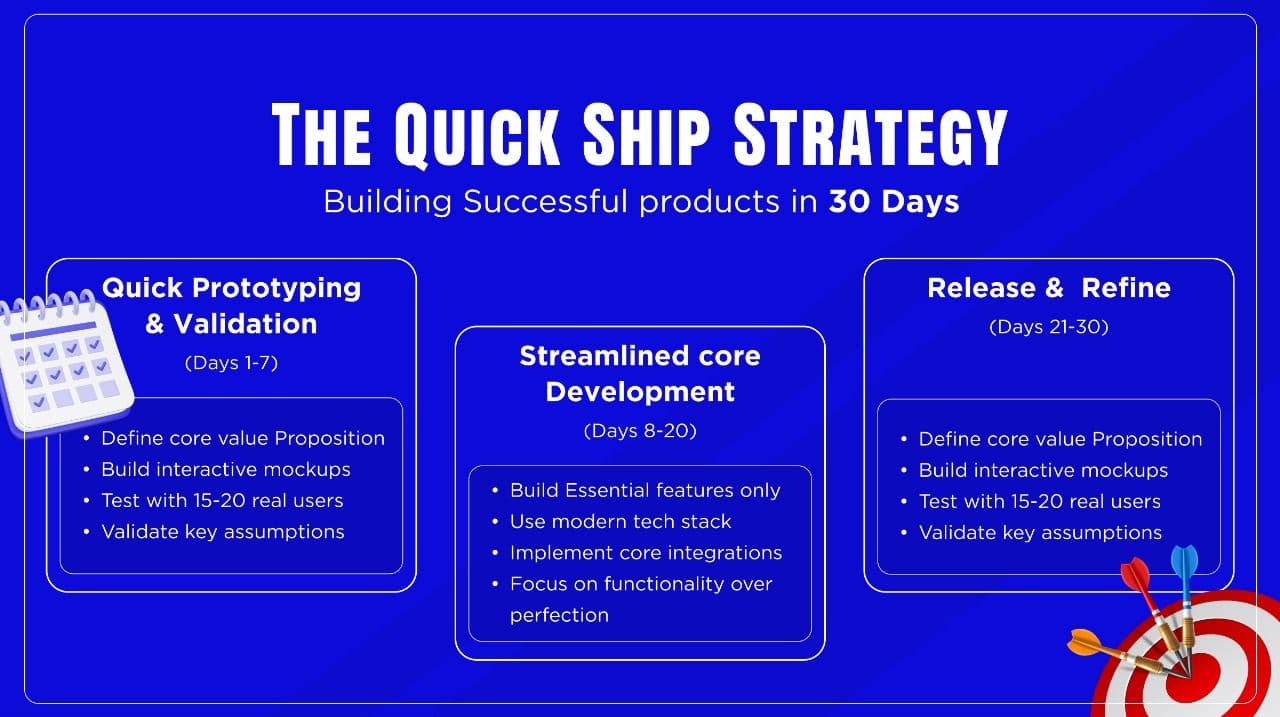
Phase 1: Quick Prototyping and Validation (Days 1-7)
The Foundation Week That Prevents Months of Wasted Development.
This opening phase eliminates the most dangerous startup killer: building something nobody wants. Instead of diving into code, you're validating assumptions with real people who might actually pay for your solution.
Day 1-2: The One-Sentence Challenge Define your value proposition in exactly one sentence. If you can't explain your solution clearly, your customers certainly won't understand it. Test this sentence with 5 different people. If they need clarification, keep refining.
Day 3-4: From Idea to Interactive Reality Using AI-powered platforms like Bolt.new or Figma, create working demonstrations of your core user journey. Focus on the 3-5 screens that showcase your main value. Don't worry about pixel-perfect design, functionality trumps aesthetics at this stage. Founders building software without technical backgrounds often leverage no-code and low-code tools, similar to the tools discussed in our guide on choosing MVP options for non-technical founders.
Day 5-7: The Reality Check Test your prototype with 15-20 people who match your target audience. Not friends being polite, real potential customers who will tell you the harsh truth.
Success metrics for week one:
- 60 percent or more testers understand your value proposition immediately
- Clear identification of 3-5 core problems your solution addresses
- Ranked list of features based on actual user priorities
- At least 3 users expressing genuine purchase intent
Phase 2: Streamlined Core Development (Days 8-20)
Building Only What Matters, Ruthlessly.
This phase requires discipline. Every feature request, every nice-to-have, every perfectionist urge gets documented for later. You're building the minimum version that proves your core value proposition works.
The Essential-Only Rule: Create three buckets from your Phase 1 feedback:
- Essential: Required for basic functionality (build these)
- Beneficial: Nice improvements (document for v2)
- Future: Advanced features (ignore completely)
Technology Stack for Maximum Velocity Modern tools eliminate weeks of setup time. Choose proven combinations:
- Backend: Supabase provides databases, authentication, and real-time features
- Frontend: Next.js with React for fast SaaS applications
- Payments: Stripe for immediate monetization capability
- Analytics: PostHog for user behavior insights
The 80/20 Development Approach focuses on the 20 percent of features that deliver 80 percent of the value. A working login system beats a perfect one. A simple payment flow beats a complex one that isn't ready.
Phase 3: Release and Refine (Days 21-30)
From Build to Business, Learning in Public.
The final phase isn't about finishing your product, it's about starting your education. Real users will teach you more in one week than months of internal planning.
The Progressive Launch Strategy:
Days 21-24: Soft Launch Start with 20-50 users from your network who will provide detailed feedback. Fix obvious bugs and usability issues before broader exposure.
Days 25-27: Systems Setup Implement analytics, error monitoring, and customer support channels. Create social media accounts and prepare basic marketing materials.
Days 28-30: Public Beta Launch to your target market through relevant communities, Product Hunt, or direct outreach. Monitor user behavior obsessively and respond to feedback immediately.
Critical Success Indicators to Track:
- User activation rate: percentage completing your core action
- Daily active users: consistency of engagement patterns
- Feature adoption: which capabilities users actually use
- Customer feedback sentiment: qualitative insights for improvement
The Post-Launch Learning Loop involves weekly feedback review sessions combining user comments, behavioral data, and support tickets. Prioritize improvements that can be implemented quickly while documenting larger requests for future development cycles.
The Power of Constraints: The 30-day constraint forces the discipline that creates successful SaaS products. When you have unlimited time, you build unlimited features. When you have 30 days, you build exactly what users need.
This framework has helped hundreds of startups launch faster, learn quicker, and build better products than traditional methods. The question isn't whether it works, it's whether you're ready to embrace the speed that today's market demands.
Critical Tools for Accelerated Product Development
The modern startup environment provides unprecedented access to powerful development tools that speed product creation without sacrificing quality. Understanding which tools to use and when can determine whether you launch in 30 days versus 30 weeks.
AI-Powered Development Revolution
Artificial intelligence has fundamentally transformed software development accessibility and speed. These tools democratize product creation and enable rapid prototyping, similar to approaches used in AI startup tech stacks and AI agents in software development to accelerate engineering workflows.
Next-Generation AI Platforms:
- Bolt.new allows founders to describe product visions in natural language and receive working applications built with React and Node.js
- Lovable.dev focuses specifically on React applications with integrated backend services
- GitHub Copilot functions as an intelligent programming partner, suggesting code completions and helping with debugging
Success Strategy: Combine AI-generated foundations with human expertise for critical product features. AI excels at standard functionality but struggles with custom business logic and nuanced UX decisions.
Backend-as-a-Service Platforms
Traditional server management consumed weeks before any product-specific development could begin. Modern Backend-as-a-Service platforms eliminate this overhead entirely.
Leading BaaS Solutions:
- Supabase for databases and real-time features
- Firebase for Google-backed ecosystems
- AWS Amplify for enterprise-scale solutions
No-Code and Low-Code Accelerators
For founders with limited technical resources, no-code platforms can provide functional MVP software within days rather than weeks.
Comprehensive Platforms:
- Bubble for complex web apps
- Webflow for websites and lightweight web apps
- Airtable for databases and workflow automation
Real-World Success Examples
The Quick-Ship Strategy isn't theoretical, it's been proven across diverse industries and company stages. These case studies demonstrate how 30-day product launches can outperform traditional development approaches.
Case Study 1: B2B SaaS Success
The Challenge: TechFlow initially planned a six-month development timeline for their project management platform.
The Quick-Ship Approach: Instead of building everything, TechFlow focused on their core value of simplifying task assignment and progress tracking.
Results:
- 500 beta users within the first month
- $15,000 MRR within 90 days
- User feedback showed mobile accessibility mattered more than advanced reporting
- Successful Series A funding based on traction
Case Study 2: Mobile-First Application
The Challenge: SocialSphere aimed to create a social platform for Gen Z.
The Progressive Approach: SocialSphere launched as a Progressive Web App (PWA), avoiding costly iOS and Android delays.
Results:
- 10,000 DAU in first quarter
- 95 percent retention after 30 days
- Native apps launched later once demand was proven
Overcoming Common Quick-Ship Objections
Despite evidence supporting rapid launch strategies, founders often resist due to misconceptions.
My Product is Too Complex for 30 Days
This objection stems from conflating product complexity with launch complexity. Even sophisticated products have a core value proposition that can be demonstrated within 30 days.
The Reality Check Process: Identify the single most valuable user action your product enables. Focus on proving the value hypothesis rather than demonstrating every feature.
Users Will Judge Us for an Imperfect Product
Users consistently prefer working solutions over perfect alternatives that don't exist yet.
Counter-Evidence:
- Users are 3x more likely to adopt imperfect products that solve problems
- Early adopters become loyal evangelists
- Feedback on imperfect products is more actionable
Investors Won't Take Us Seriously
Modern investors prefer evidence over promises. Traction beats theory.
What Investors Actually Want:
- User engagement data
- Revenue or clear monetization path
- Evidence of product-market fit
- Team execution capability
- Clear growth trajectory
This mirrors modern expectations seen in startup fundraising environments, especially in the Australian startup ecosystem using offshore development partnerships to scale quickly.
Getting Started with the Quick-Ship Method
Transitioning to the Quick-Ship Method requires mindset shifts and practical preparation. This implementation guide provides concrete steps for founders ready to embrace rapid software shipping.
Foundation Week: Strategic Preparation
Define Your Core Value Proposition Write a one-sentence description of the problem you're solving, for whom, and why your solution is uniquely better.
Choose Your Technical Foundation Select tools your team already understands.
Popular Combinations:
- Frontend: React with Next.js for web SaaS
- Backend: Supabase or Firebase
- Deployment: Vercel or Netlify
- Monitoring: PostHog and Sentry
Assemble Your Team Identify who will handle development, design, and user testing during the sprint.
Development Sprint: Execution Phase
Week 2: Core Infrastructure for authentication, core flows, and DB schemas.
Week 3: Feature Implementation focusing exclusively on must-have MVP features.
Launch Week: Going Live
Soft Launch Strategy (Days 22-24) Network users for early feedback.
Public Launch Preparation (Days 25-27) Deploy analytics, support, and social channels.
Beta Launch Execution (Days 28-30) Launch to real users, communities, and channels relevant to your market.
The Competitive Advantage of Speed
In today's hyper-competitive startup landscape, speed is a strategic advantage that compounds over time.
First-Mover Benefits in Practice
Early market entry provides:
- Media coverage and visibility
- User loyalty and retention
- Unique partnership opportunities
Learning Velocity as Competitive Advantage
User data eliminates guesswork, enabling confident product decisions.
Resource Efficiency and Capital Advantages
- Lower development costs
- Faster revenue generation
- Higher investor confidence
Conclusion: Speed as Your Strategic Advantage
The startup landscape has fundamentally transformed. Traditional development cycles now represent competitive suicide in markets where preferences shift monthly and competitors emerge overnight.
The old playbook of stealth building and long timelines is obsolete. Today's successful founders ship fast, learn quickly, and iterate often. Modern development platforms, AI tools, and BaaS solutions have democratized software creation. The barriers to rapid shipping have never been lower.
The future belongs to founders who embrace speed. Your competitors are already building. Your users are already searching for solutions. Your market is already evolving.
Are you ready to launch in 30 days, or will someone else capture your opportunity while you're still preparing?
Frequently Asked Questions (FAQs)
1. What is the Quick-Ship Strategy in startup product development?
The Quick-Ship Strategy is a 30-day product launch framework that helps startups build a functional MVP fast, validate real user demand, and avoid long development cycles that waste time and capital.
2. How can a startup launch an MVP in 30 days?
Startups can launch in 30 days by validating the idea early, building only essential features, using no-code or AI-assisted tools, and releasing a working version to real users for fast feedback. This reduces risk and accelerates product-market fit.
3. Why is a long development cycle risky for new startups?
Long development timelines are risky because user needs change quickly, competitors move faster, and assumptions may be wrong. Without early validation, startups often build features customers do not want.
4. Do users accept early or imperfect MVPs?
Yes, users accept early versions if the product solves a real problem. Early adopters prefer functionality over polish, and they provide valuable feedback that guides the next iteration.
5. Can non-technical founders use the Quick-Ship Method?
Absolutely. With AI coding tools, no-code platforms, and offshore development partners, non-technical founders can launch functional MVPs quickly without deep engineering skills.
6. How does the 30-day launch strategy attract investors?
Investors prefer real traction. A live MVP with early users, activation metrics, and revenue tells a stronger story than projections. Fast execution signals a capable team.
7. What tools are best for fast MVP development?
Popular fast-launch tools include Next.js, Supabase, Firebase, Bubble, Figma, Bolt, AI agents, and Vercel. These reduce setup time and allow startups to ship core features faster.