
AI Startup Tech Stack: Tools Every Founder Needs to Build Faster
 Probits
The startup world has changed overnight. What used to take months and hundreds of thousands of dollars can now happen in weeks with the right modern startup stack and AI startup tools.
Gone are the days when launching a startup meant raising massive rounds, hiring armies of developers, and praying your MVP would find product-market fit. Today's successful founders think differently. They use AI-powered tools and modern platforms to validate ideas faster, build smarter, and scale without breaking the bank, often combining this with structured MVP validation before scaling.
But here's the catch: knowing which tools to use and how to combine them into a cohesive startup tech stack makes all the difference.
Why the Traditional Startup Playbook Is Broken
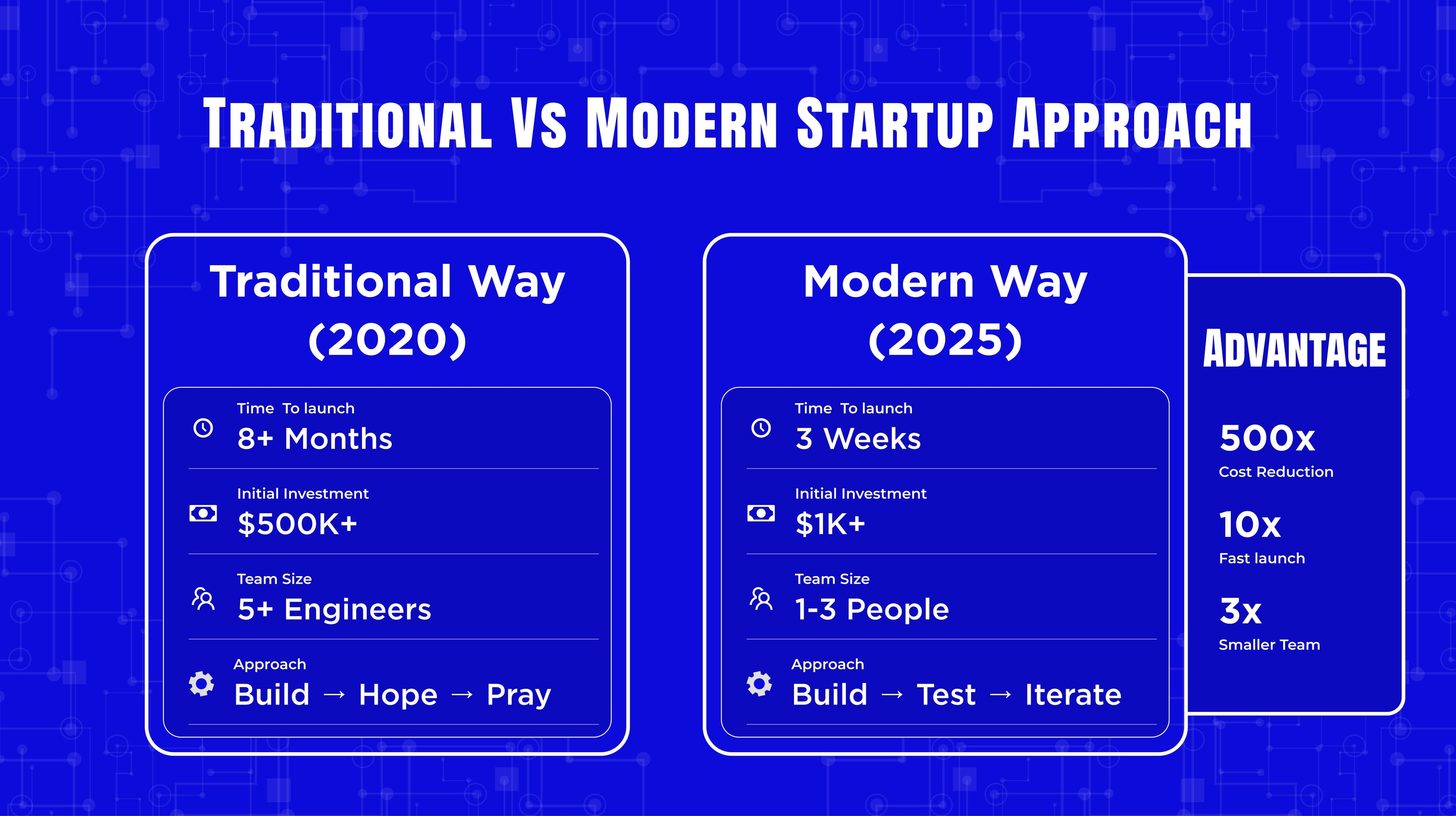
Picture this: Sarah has a brilliant idea for a fitness app. In 2020, she would have needed to raise $500K, hire a team of five engineers, and spend eight months building before getting her first real user feedback.
By then? The market might have shifted. Competitors could have launched. Her runway would be burning fast.
The old model was built on assumptions and guesswork. Build first, validate later. It worked when competition was slower and capital was patient. But today's market moves at internet speed, and founders need AI-first tools and a lean startup stack that match that pace. Approaches like launching in 30 days, as explored in guides on how to launch a software product in 30 days, are now the norm for high-performing teams.
The Modern Startup Stack That Changes Everything
Think of the modern startup stack as your business superpower. Instead of reinventing every wheel, you plug into services that handle the heavy lifting: infrastructure, payments, user management, analytics, even AI-assisted code generation. This leaves you free to focus on what actually matters: solving real problems for real people and shipping a minimum viable product that users will actually pay for.
Here's how today's smartest founders are building with an AI startup tech stack.
AI-Powered App Builders - From Idea to Interface in Hours
These platforms turn plain English descriptions into working applications. No computer science degree required. They are perfect for AI rapid prototyping and short feedback cycles.
Bolt acts like having a senior developer on speed dial. You describe your product vision: "I want a marketplace where freelancers can bid on projects" and Bolt generates the foundation code. Real applications, not just mockups.
Lovable goes even further for non-technical founders. Sarah from our fitness app example could describe her workout tracking features in everyday language. Lovable handles the translation from concept to code.
The result? What used to take weeks of developer time now happens in hours. This is the same mindset behind AI rapid prototyping to build an MVP in 7 days, where speed, feedback, and iteration matter more than perfection.
Frontend and Hosting - Making Your Product Lightning Fast
Your brilliant app needs a home on the internet, and it needs to load instantly. Nobody waits for slow websites anymore, and performance is a direct ranking factor in SEO for startups.
Next.js has become the go-to framework for building web applications that feel native. It handles the technical complexity of making sites fast and search-engine friendly automatically. Major companies like Netflix and Uber use it for good reason, and it fits perfectly into a modern startup tech stack.
Vercel pairs perfectly with Next.js for hosting. Every time you make changes, you get an instant preview link to share with your team or early customers. No complex deployment pipelines or server management headaches.
Backend Infrastructure - The Foundation That Scales
Every app needs a database, user authentication, and payment processing. These used to require separate services and weeks of integration work. With a modern startup stack, you can plug in scalable infrastructure from day one.
Supabase bundles database, authentication, and file storage into one platform. It automatically creates APIs for your data and supports real-time features like live chat or collaborative editing. Plus, it's open source, so there is no vendor lock-in.
Clerk handles user accounts and login systems. Email signup, Google sign-in, passwordless authentication, user profiles all working out of the box. One line of code, and you've got enterprise-level user management.
Stripe remains the gold standard for payments. Whether you're charging once or building subscription billing, Stripe handles the complexity of international payments, tax compliance, and fraud prevention.
This combination gives you a robust backend without hiring a full backend team. For many founders, this stack becomes the backbone of their MVP, especially when working with offshore software development teams who can focus on higher-value features instead of boilerplate infrastructure.
Analytics and Error Monitoring - Building With Your Eyes Open
Launching fast is great. But you need to see what's working and catch problems before they frustrate users. A data-driven startup tech stack is what separates guesswork from informed decisions.
PostHog provides the analytics insights you need without sending your users' data to Google. See how people actually use your product, where they get stuck, and what drives conversions. The session recordings feature is like having a window into your users' experience.
Sentry catches bugs and performance issues before they become customer complaints. It monitors your app continuously and alerts you when something breaks, complete with the technical details your team needs to fix it quickly.
With these tools, you are not just launching a product. You are building a feedback loop that informs your roadmap, improves your user experience, and strengthens your case for investors.
Team Organization - Staying Aligned Without the Overhead
Even small teams need structure, but most project management tools are bloated messes designed for large enterprises.
Notion serves as your startup's central nervous system. Product roadmaps, meeting notes, launch checklists, company knowledge all in one searchable place. Teams use it to stay aligned without drowning in documentation. It is especially powerful for distributed teams and startups combining onshore leadership with offshore or dedicated remote development.
Linear keeps development tasks moving. Unlike bloated alternatives, Linear focuses on speed and simplicity. Your engineering team can track progress without getting lost in unnecessary features. Together, Notion and Linear become core parts of the internal startup stack that supports consistent shipping.
AI Developer Support - Amplifying Human Talent
AI doesn't replace developers, it makes them dramatically more productive by handling the routine work and boilerplate code.
GitHub Copilot acts as an AI pair programmer. It writes boilerplate code, suggests improvements, and handles repetitive tasks. Experienced developers report 30 to 50 percent productivity gains, while newer programmers learn faster by seeing AI-generated examples.
This is where AI agents and AI-powered development workflows intersect with traditional engineering. Startups that adopt AI agents in software development to scale faster at lower cost can ship features faster without sacrificing quality.
Real-World Example: From Vision to Live Product in Three Weeks
Let's follow Sarah's fitness app journey using this modern startup stack and AI startup tools.
Week 1: Sarah maps her product vision in Notion, creating user personas and feature lists. She uses Lovable to build her first working prototype, a simple interface where users can log workouts and track progress.
Week 2: The prototype gets upgraded with Supabase for user data and workout video storage. Clerk handles user accounts while Stripe processes subscription payments. The app is deployed on Vercel with a polished Next.js frontend.
Week 3: Sarah launches to 50 beta users. PostHog shows which features get used most, while Sentry catches and fixes a critical bug in the workout timer. Based on user feedback captured through PostHog's session recordings, she iterates on the workout discovery flow.
Result: In three weeks, Sarah has a polished product with paying beta customers, all without hiring a full engineering team or burning through a massive budget. This is exactly how a well-designed AI startup tech stack turns a vision into a live, validated product.
Why This Approach Wins in Today's Market
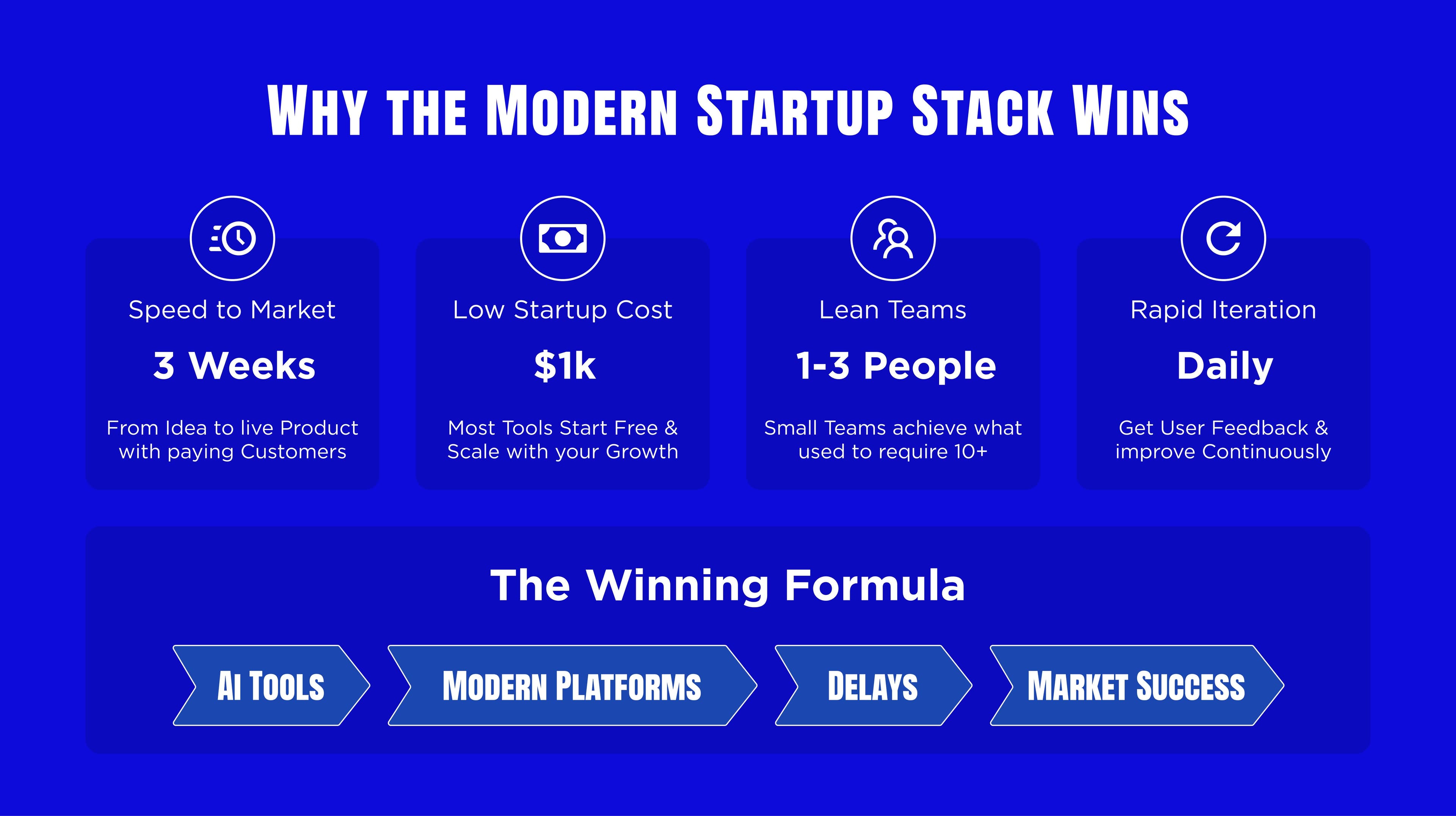
This new model flips traditional startup thinking. Instead of building in isolation and hoping for the best, you validate continuously and iterate based on real user behavior, much like modern MVP validation frameworks.
Speed beats perfection. Get a working version in front of users quickly, then improve based on actual feedback rather than assumptions. This speed is what allows founders to avoid the biggest MVP mistakes startups make.
Costs stay manageable. Most of these tools offer generous free tiers that scale with your growth. You're not paying enterprise prices for startup-level usage.
Small teams achieve big results. The right modern startup stack lets three people accomplish what used to require a team of ten.
In a world where AI tools, cloud infrastructure, and no-code platforms are widely available, the real differentiator is how quickly you can learn from your users and adapt.
Avoiding Common Pitfalls
Moving fast can create new problems. Here's what to watch out for when using an AI-powered startup tech stack.
Don't trust AI blindly. Generated code can contain subtle bugs or security issues. Always have someone technical review AI outputs before they go live. Technical oversight is crucial, whether that comes from in-house engineers or experienced offshore software partners.
Budget for scale. Free tiers are generous, but they end. A fitness app with 10,000 active users will face different costs than one with 100. Plan accordingly so your infrastructure costs do not surprise you at exactly the wrong time.
Understand your legal obligations. AI-generated content and code may raise intellectual property questions. Some companies require human oversight for compliance reasons, especially in regulated industries or markets like Australia and Europe.
Where Human Expertise Still Matters
AI accelerates execution, but human judgment remains irreplaceable. The most successful startups pair these tools with strategic expertise and the right people.
Technical oversight ensures AI-generated code meets production standards. Consider offshore development partners or senior engineers who can review and refine automated outputs while leveraging quality-focused outsourced teams.
Product strategy keeps your rapid building aligned with customer needs, not just technical possibilities. Someone still needs to decide what to build, who it serves, and how it fits into your overall business model.
Design thinking adds the empathy and aesthetic sense that AI struggles with. Users notice the difference between functional and delightful, and those details often decide whether your product stands out or blends into the noise.
Security From Day One
Moving fast cannot mean compromising on security. User trust, once broken, is nearly impossible to rebuild.
Data protection starts with your tool choices. Supabase and Clerk offer built-in compliance features, but sensitive user data requires additional safeguards, especially if you are operating in industries with strict privacy expectations.
Authentication security must be part of your MVP, not a later addition. Use established services like Clerk rather than building your own login systems from scratch.
Continuous monitoring helps catch security issues early. Tools like Sentry can detect unusual patterns that might indicate vulnerabilities or misuse, allowing you to act before it becomes a major incident.
Security is part of building a modern startup stack, not an afterthought.
The Future of Startup Building
The traditional startup playbook, raise big, hire fast, build slow, is becoming obsolete. The new model is clear: use AI and modern platforms to move from idea to market-tested product in weeks, not months.
This isn't about building worse products faster. It's about building better products by staying close to your users throughout the development process. When iteration cycles shrink from months to days, you can afford to experiment, learn, and improve continuously.
The founders who master this AI-first, stack-driven approach will have an enormous advantage over those still following the old playbook. They will build stronger MVPs, validate faster, and scale smarter with the help of the right startup tech stack and, when needed, trusted offshore development partners.
At Probits, we help startups combine AI-powered development tools with dedicated offshore teams, ensuring you don't just build fast, you build right. Ready to transform your startup idea into a market-tested product with a modern startup stack? Let's talk.
Frequently Asked Questions (FAQs)
1. What is a modern startup tech stack? A modern startup tech stack is a set of tools and platforms that help founders build, launch, and scale products faster using AI, cloud services, and no-code/low-code frameworks. It typically includes hosting (Vercel), frontend (Next.js), backend (Supabase), auth (Clerk), payments (Stripe), analytics (PostHog), and developer AI tools like GitHub Copilot.
2. Why are AI tools useful for startups in 2025?
AI tools are useful for startups in 2025 because they automate development tasks, accelerate prototyping, reduce costs, and support faster validation of product ideas. Startup founders use AI for coding, UX design, research, and workflow automation, which shortens development time from months to weeks.
3. Can non-technical founders build a product with this stack? Yes, non-technical founders can build products using this stack by combining no-code app builders, Backend-as-a-Service platforms, and AI assistants. Tools like Lovable, Bolt, Supabase, and Clerk reduce the need for advanced coding skills, while offshore development teams can handle complex features if needed.
4. How does a modern startup stack reduce costs?
A modern startup stack reduces costs by eliminating the need for large engineering teams, replacing custom infrastructure with cloud services, and providing generous free tiers for early usage. Instead of hiring backend, DevOps, and infrastructure experts, founders rely on managed platforms that scale on demand.
5. How fast can you launch an MVP using this stack?
Most founders can launch a functional MVP within 2 to 6 weeks using AI-powered tools and cloud platforms. With structured sprint workflows and lean validation, some early-stage products ship in as little as 7 to 30 days depending on complexity and user requirements.
6. Is this startup stack scalable for product-market fit and growth?
Yes, this stack is scalable because tools like Supabase, Vercel, Clerk, and Stripe support production-grade usage, global traffic, and enterprise-level security. Startups can grow from 10 beta users to 10,000 active users without rebuilding infrastructure or migrating services.
7. Should Australian startups use offshore development with this stack?
Australian startups often combine this stack with offshore development teams to increase delivery speed, reduce engineering costs, and access specialized expertise. Offshore partners can handle architecture, security, and optimization while founders focus on product, users, and market validation.