
How to Choose an MVP Development Company in Australia (2026 Checklist)
 Niresh Lamsal
Choosing an MVP development company is mostly about risk. You're handing your first real budget, and often your only shot at proving the idea, to people you met a few weeks ago. A good MVP development company will cut your scope, show you working software every week and hand over code you own. A bad one can keep sending invoices and status reports until the money runs out.
We're one of the companies you might be comparing (Probits' MVP development team is Australian-led, with developers in Nepal), so read this with that in mind. Everything below is the checklist we'd want a founder to run on us.
How do you choose an MVP development company?
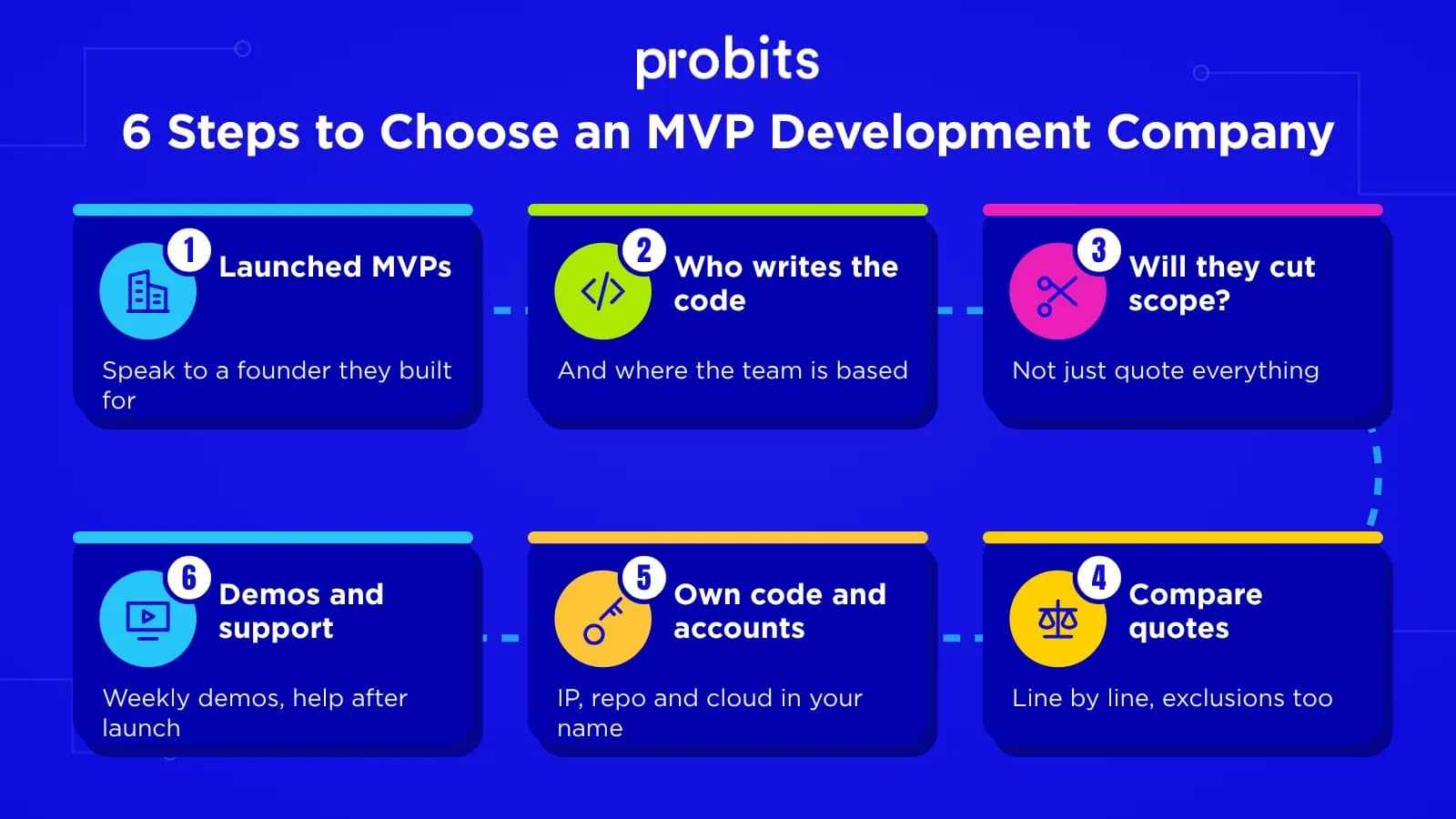
To choose an MVP development company in Australia:
- Check they've launched MVPs, and speak to one of those founders.
- Find out who writes the code and where they're based.
- Test whether they'll cut scope or just quote everything.
- Compare quotes line by line.
- Get IP, code and cloud accounts in your name.
- Agree on weekly demos and post-launch support.
Types of MVP development company in Australia
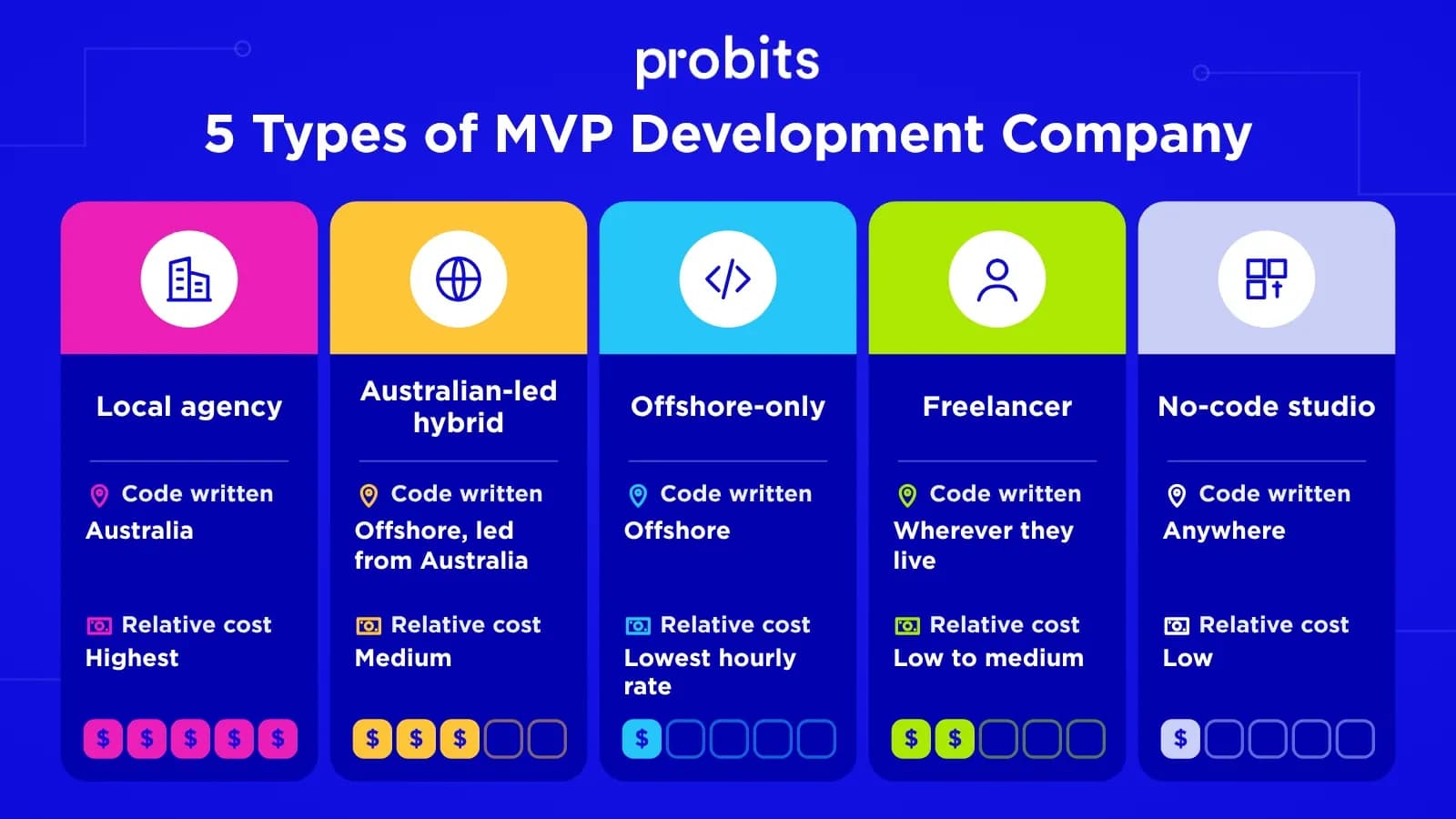
Search "MVP development company Australia" and you'll get a mix of very different businesses, all using the same words. Sort them by who builds the product before you compare anything else.
| Type | Where the code is written | Relative cost | Works well for | Main risk |
|---|---|---|---|---|
| Local agency | Australia | Highest | Complex or regulated products, founders who want everyone in the same city | Price; some quietly subcontract offshore |
| Australian-led hybrid | Offshore, with product management in Australia | Medium | Custom MVPs on a startup budget | Quality depends on how well the two halves work together |
| Offshore-only company | Offshore, sometimes with an Australian sales office | Lowest hourly rate | Founders with clear specs and time to manage the project | Communication, time zones, hidden management cost |
| Freelancer | Wherever they live | Low to medium | Small, tightly scoped builds | Single point of failure; you become the project manager |
| No-code / AI builder studio | Anywhere | Low | Validation MVPs and simple workflows | Platform limits and a rebuild later |
Which one fits depends on the product. A health-data product with integrations into hospital systems probably belongs with a local or hybrid team. A booking tool for dog groomers might be fine with a good freelancer. Budget narrows it down too, since MVP development cost in Australia ranges from a few thousand dollars for a validation MVP to well over AUD 90,000 for a complex build.
1. Check they've launched MVPs before
Building an MVP is a different job from building enterprise software. Enterprise projects reward completeness. MVPs reward cutting things out, shipping in weeks and changing direction when users don't behave the way you expected.
So "15 years in software development" tells you less than it sounds. Ask instead:
- Which MVPs have you launched in the last 18 months?
- Is the product still live? Can I sign up and use it?
- What did the founder cut from the first version, and why?
- Can I speak to that founder?
Push hardest on the last one, because a reference call with a founder whose product was similar in size to yours tells you more than any case study page. Ask them what went wrong (something always does) and how the company handled it. If the answer is "nothing went wrong", the reference has probably been coached.
Clutch and GoodFirms reviews are useful for spotting patterns across a lot of clients. Read the three-star reviews first. They're usually the most honest.
2. Find out who writes the code
Founders often forget to ask this. A Sydney or Melbourne address on the website doesn't tell you where your developers sit. Plenty of "Australian" MVP development companies sell locally and build offshore, which is fine (we do it too) as long as they tell you. The problems start when they don't. You think you're paying for a local team, the work is passed to a subcontractor you've never met, and nobody on the call can answer a technical question without "getting back to you".
Ask for:
- the names and roles of the people who'll work on your product
- where each of them is based, and their working hours in AEST
- a call with the tech lead before you sign, not after
- whether any part of the work will be subcontracted
You can also check the company itself on the ABN Lookup register. It takes thirty seconds and shows whether the business is registered in Australia and how long it's been trading.
With offshore and hybrid teams, time zones and team structure matter as much as the rate when choosing an offshore development partner.
3. Test whether they'll cut your scope
Send every shortlisted company the same feature list. Then watch what comes back.
A weak MVP development company quotes all of it. Twenty features, twenty line items, a big number and a start date.
A good one argues with you. It asks which assumption you're trying to test, suggests dropping the native app for now, and asks whether the admin dashboard could be a spreadsheet for the first three months. Some of the best MVP partners will tell you to validate your MVP idea with a landing page or a concierge test before you spend anything on development at all.
That pushback is the product thinking you're paying for. A company that quotes everything you asked for without questions will build everything you asked for, too, including the parts nobody uses.
A good MVP development process usually starts with a short paid discovery phase: user flows, the riskiest assumption, a prioritised feature list (MoSCoW works well) and a clickable prototype. If the question is purely technical (can this even be built?), a proof of concept is often the cheaper first step.
4. Compare quotes line by line
Three quotes for the same MVP can easily sit at AUD 25,000, AUD 50,000 and AUD 100,000. Usually they're quoting different things.
Before you compare totals, check each quote for:
- the number of screens and user flows included
- whether it's a demo on a staging link or a live, monitored production app
- automated testing, or a quick manual check
- template design or custom design
- what happens when you change something mid-project
- how many weeks of bug fixes are included after launch
Then look at the pricing model. Fixed price gives you certainty but needs a tight scope, and changes cost extra. Time and materials is more flexible but can run on indefinitely, so ask for a cap. A fixed-price discovery phase followed by a capped build is a sensible middle ground for most MVPs. (Our fixed-price software development for startups works this way, quoting against a set feature list.)
The cheapest quote often leaves out testing and post-launch support, and six months later it can end up costing the most.
5. Own your code, IP and accounts from day one
Under Australian copyright law, code written by a contractor generally belongs to the contractor unless the rights are assigned to you in writing. Paying the invoice doesn't transfer ownership on its own. Your contract needs a clause that assigns the intellectual property in the custom work to you, ideally on payment of each milestone rather than at the very end.
Ownership on paper isn't enough, though. Check where things live in practice:
- Code repository: in your GitHub or GitLab organisation, with the company added as collaborators
- Cloud hosting: in your AWS, Google Cloud or Vercel account, billed to you
- Domain and DNS: registered in your name
- App store accounts: Apple and Google developer accounts in your company's name
- Third-party services: Stripe, email and analytics accounts owned by you
Some founders only find out at the worst possible moment that the agency holds the only admin login to their production server. Set up the accounts yourself and invite the company in. It takes an afternoon.
Ask, too, what happens if you end the contract early. A fair contract says the code, credentials and documentation for work you've paid for are handed over within a set number of days. If you're signing a company's standard-form contract as a small business, Australia's unfair contract terms protections may also apply, but a clear handover clause is far easier than relying on them.
6. Agree how you'll see progress
A weekly status report tells you what the team says it did. A demo lets you see it. Agree on the rhythm before work starts:
- a demo of working software every one or two weeks
- a staging link you can click through yourself between demos
- one named person who answers your questions, and how quickly
- how to escalate if something is going wrong
Weekly demos catch misunderstandings while they're still cheap. A founder who first sees the product in week ten often finds out it was built around a misread requirement in week two.
If the team is offshore, ask how many hours of their day overlap with yours and when meetings will happen. A team that only meets you at 9pm AEST will wear you down, and regular shared hours do a lot of the work of building trust with an offshore development team.
7. Ask what happens after launch
Launch is when you start getting real information, and you'll want to act on it quickly. A company that disappears after go-live leaves you hiring someone new to learn an unfamiliar codebase at exactly the moment you need speed.
Check:
- how long the post-launch bug-fix period is, and what counts as a bug
- whether they offer ongoing support, and on what terms
- what documentation you'll get (setup, deployment, architecture)
- whether another developer could pick the project up if you parted ways
The handover question doubles as a test of code quality. Ask how they'd hand the project to another team, and listen for a confident, specific answer. Skipped monitoring, missing documentation and no one on call are common reasons applications fail in production.
8. Check security and privacy, even for a small MVP
Most MVPs handle personal information from day one: names, emails, sometimes payments or health details. Ask how the company handles access:
- individual accounts for each developer, with multi-factor authentication
- no shared passwords for production systems
- developers working with test data rather than real customer data where possible
- removing access when someone leaves the project
If an offshore team will see personal information about your users, think about the Australian Privacy Principles. Under APP 8, a business covered by the Privacy Act that discloses personal information overseas generally remains accountable for how the overseas recipient handles it. Ask the company how they'd keep real customer data out of developers' hands where possible, and get advice if you're in health or finance.
Red flags when choosing an MVP development company
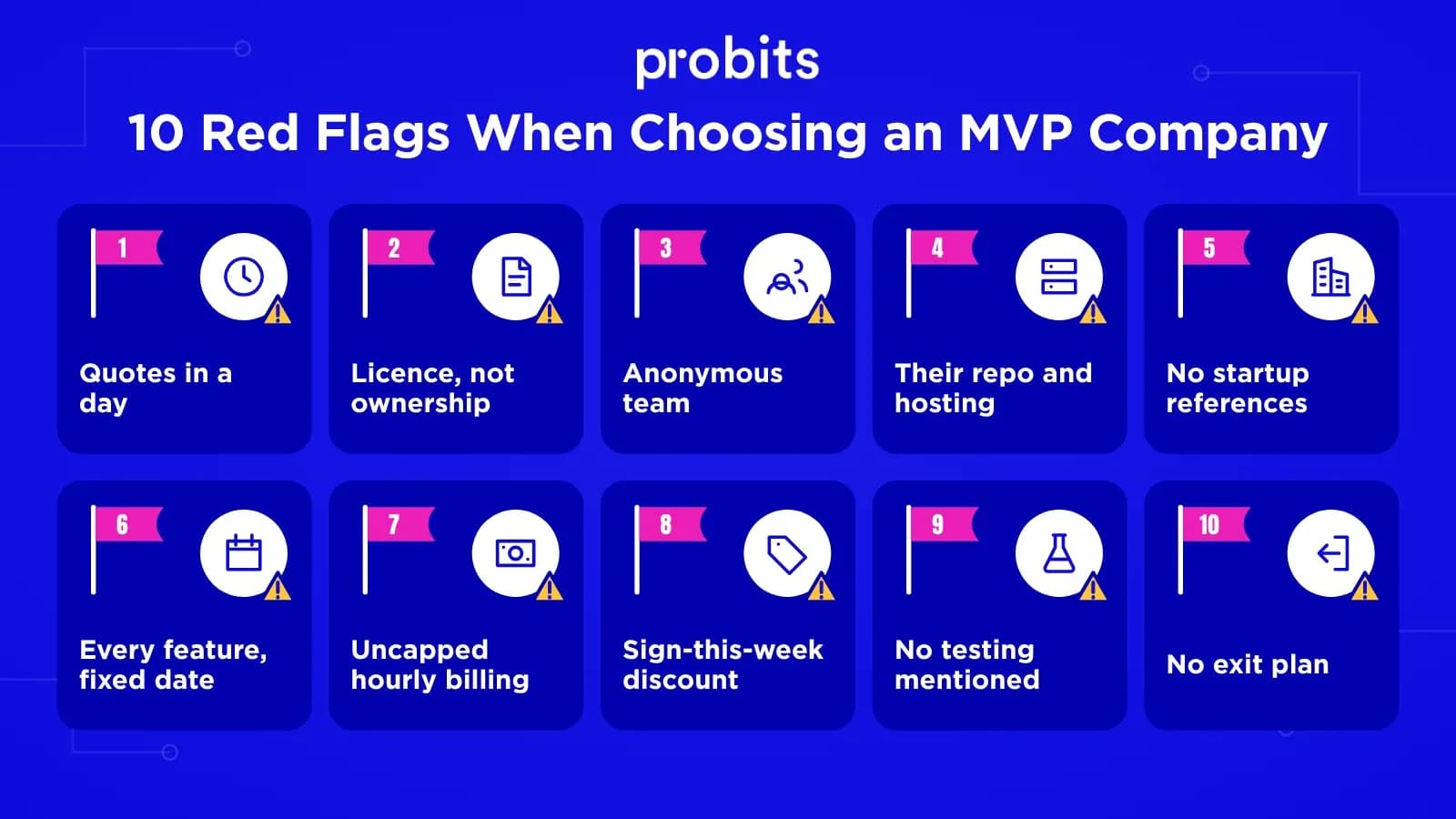
- They quote within a day of seeing your idea, with no questions about users or goals.
- The contract gives you a "licence" to use the code rather than ownership.
- You can't meet or name the people building your product.
- The code repository and hosting will sit in their accounts.
- Every reference is a large enterprise client, with no startups.
- They promise a fixed timeline and every feature, with no trade-offs.
- Time and materials pricing with no cap and no estimate.
- A discount that expires if you don't sign this week.
- No mention of testing anywhere in the proposal.
- They can't explain what happens if you end the contract.
One of these on its own might have an innocent explanation. Two or three together is a reason to walk away.
Questions to ask an MVP development company before you sign
- Which MVPs have you launched in the last 18 months, and can I speak to one of those founders?
- Who will build my product, where are they based, and can I meet the tech lead?
- Will any of the work be subcontracted?
- What would you cut from my feature list, and why?
- What exactly is excluded from this quote?
- Is the price fixed, capped, or open?
- How do you handle changes halfway through?
- Will the code, cloud and app store accounts be in my name from day one?
- Does the contract assign IP to me on payment?
- How often will I see working software?
- What support do I get after launch, and for how long?
- If we stop working together, what do I get and how quickly?
If you're not technical yourself, these questions matter even more because you can't check the code. It also helps to know your MVP options as a non-technical founder, including no-code tools and technical co-founders, before you start talking to agencies.
How to read "top MVP development companies in Australia" lists
You'll find plenty of "Top 10 MVP development companies in Australia" articles. Look at who published each one. Very often it's one of the companies on the list, and it tends to rank itself near the top.
The lists are still a reasonable way to build a long list of names. Just don't treat a ranking as evidence. Shortlist three or four companies, then run each through the checklist above. The founder reference call will tell you more than any ranking.
MVP development company scorecard
Score each company 0 (no), 1 (partly) or 2 (yes) on each line. Anything below 12 out of 20 needs a hard conversation before you sign.
| Criterion | What "yes" looks like | Score |
|---|---|---|
| MVP track record | Live MVPs launched in the last 18 months | |
| Founder reference | You spoke to a founder with a similar-sized product | |
| Named team | You know who builds it, where, and you've met the tech lead | |
| Scope pushback | They suggested cutting or simplifying features | |
| Clear quote | Inclusions and exclusions written down | |
| Pricing model | Fixed, or capped time and materials | |
| IP ownership | Written assignment of IP to you on payment | |
| Your accounts | Repo, cloud, domain and app stores in your name | |
| Demo rhythm | Working software every one or two weeks | |
| After launch | Defined bug-fix period, support terms and handover plan |
FAQs about choosing an MVP development company
How much does an MVP development company charge in Australia?
A simple custom MVP with one core workflow typically costs AUD 15,000 to 40,000, and a standard MVP with payments and integrations around AUD 40,000 to 90,000. Validation MVPs can cost far less.
Should I choose a local or offshore MVP development company?
Choose local if you need the team in the room, work in a heavily regulated area, or have the budget. Offshore and hybrid teams cost less per hour but need clear requirements and someone who owns the product. The local vs offshore app development trade-offs go well beyond the hourly rate.
How long should an MVP development company take?
A simple custom MVP usually takes 6 to 10 weeks, and a standard MVP 10 to 16 weeks, after discovery. Be wary of anyone promising a complex product in a fortnight, and equally of a simple one stretching past four months.
Is a freelancer cheaper than an MVP development agency?
Usually per hour, sometimes overall. A freelancer can work well for a tightly scoped build if you can manage the project yourself. An agency costs more but covers design, testing and project management, and doesn't stop if one person gets sick.
What should be in an MVP development contract?
The scope with inclusions and exclusions, the pricing model and any cap, a change process, IP assignment to you, where code and accounts will live, a bug-fix warranty period, and what's handed over if the contract ends early. Have a lawyer read it if the build is large.
Can I switch MVP development companies halfway through?
Yes, if you own the code and accounts and the code is documented. Without those, switching can mean starting again.
Choosing an MVP development company on evidence
Every MVP development company will tell you it's fast and startup-friendly. Collect evidence instead: a founder you spoke to, a team you met, a quote you understood, a contract that gives you the code. The company that's comfortable with all four is usually the one to trust.
If you'd like to put Probits through this checklist, book a free consultation. You can look through the MVPs and apps we've built and ask us for a founder to speak to.