
How to Build an AI Agent: Beginner-Friendly Step-by-Step Guide (2026)
 Probits
Back in 2020, the most exciting thing about conversational AI was the chatbot. It could answer customer service queries, check account balances, or reply to common FAQs. They were helpful, but limited. They relied heavily on humans to prompt them, and they were often frustrated when asked to handle anything outside their narrow scripts.
Fast forward to 2025, and the picture looks completely different. The world has entered the age of AI Agents. These systems are not simply reactive tools waiting for a question. They can make decisions, take initiative, access data from multiple sources, and act on your behalf with minimal supervision. Think of them less as chatbots and more as digital colleagues.
Today, startups, solopreneurs, and even hobbyists are building AI agents to automate tasks, streamline workflows, and create new business opportunities. From financial trading bots that monitor global markets around the clock to content agents that automatically summarize daily tech news, the uses are multiplying every month.
The most exciting part is that you do not need advanced programming skills or a huge budget to start building. With beginner-friendly frameworks, cloud tools, and no-code platforms, you can create your own AI agent in less than an hour. This blueprint will guide you step by step, explaining what agents are, which tools you need, how to avoid common mistakes, and exactly how to build a simple agent as your first project.
AI agents are also highly complementary to the processes used in AI rapid prototyping. Startups using AI agents can automate repetitive tasks, test features faster, and integrate with MVP workflows, making them ideal for those following our guide on AI rapid prototyping to build an MVP in 7 days.
Why AI Agents Matter in 2026
AI agents matter because they go beyond simple automation. A chatbot is like a calculator that waits for input. An agent is more like a junior assistant who notices gaps, proposes solutions, and follows through on tasks you give them.
Key drivers of the 2025 AI agent boom include:
1. Accessibility through no-code platforms: Platforms such as Sim allow beginners to visually design workflows by dragging and dropping components, eliminating the need for advanced coding skills. Non-technical founders who are exploring MVPs will find this approach ideal when compared to traditional budget MVP development options.
2. Integration with finance and blockchain: Decentralized finance has created opportunities for agents that trade, rebalance portfolios, or monitor crypto wallets autonomously.
3. Multimodal power: Modern models process text, images, and voice commands, allowing a personal research assistant to read reports, check graphs, and explain trends in plain language.
4. Trust and ethical design: Privacy, fairness, and transparent reasoning are essential in 2025. Platforms that embed these safeguards are more likely to be adopted by Australian startups and global remote teams, tying into considerations for offshore development in 2026.
How Businesses Are Using AI Agents
- Marketing teams automate competitor monitoring and daily summaries.
- Freelancers deploy job-hunting agents that filter and rank opportunities.
- E-commerce stores use AI agents to handle 70 percent of support queries.
These practical use cases show that AI agents are not experimental, they are real tools driving productivity, similar to how AI agents in software development help startups scale faster.
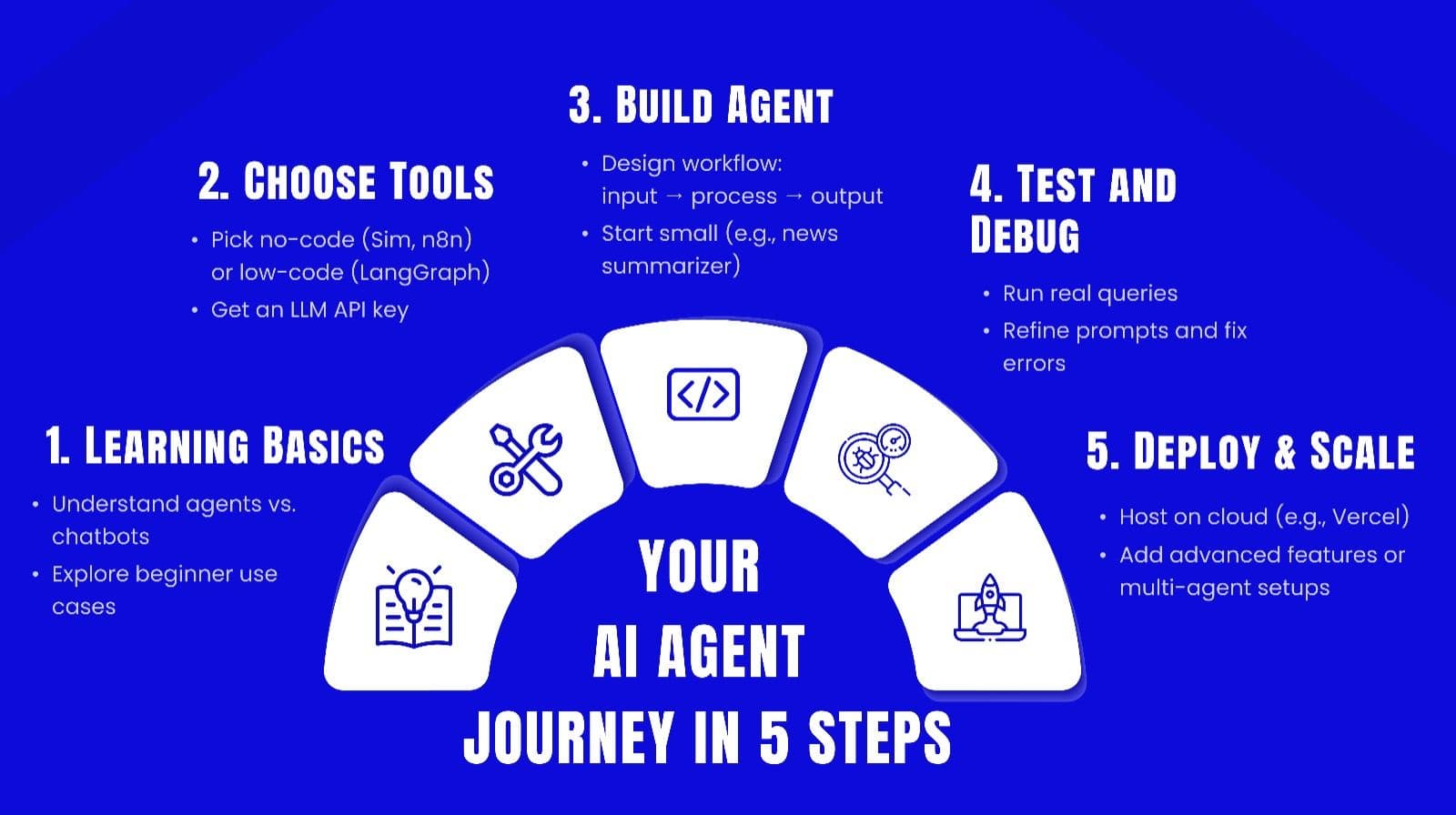
Understanding AI Agents: Beyond Chatbots
To build one, you need to clearly understand what separates an AI agent from earlier generations of conversational AI.
What Is an AI Agent?
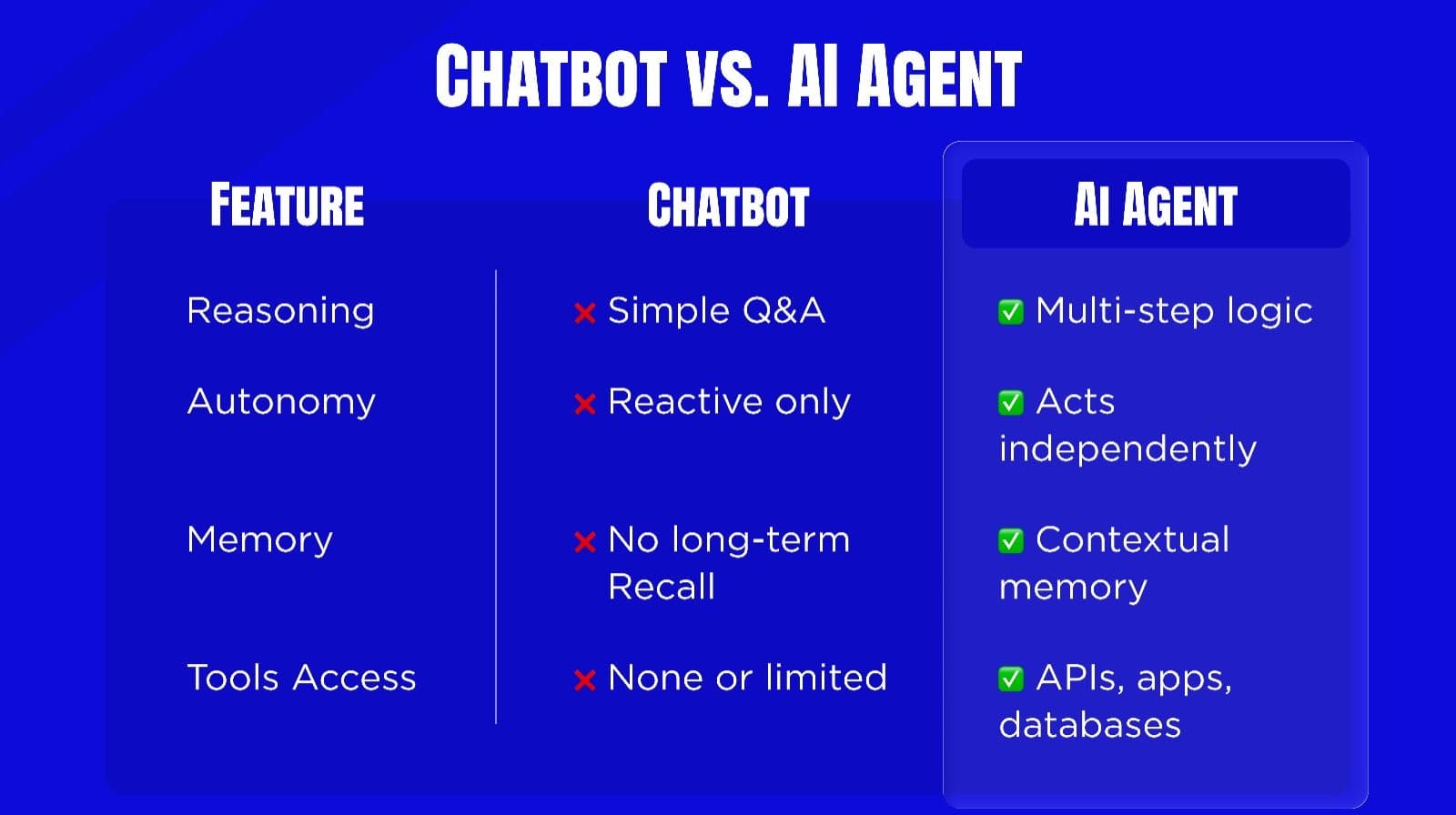
An AI agent is a system powered by a large language model that is capable of reasoning, planning, and taking action. Unlike a chatbot that only reacts when you type something, an agent can:
- Access external tools such as APIs or databases
- Retain memory of past interactions
- Act autonomously to achieve a defined goal
This autonomy makes AI agents perfect for automating workflows, analyzing MVP performance, or even contributing to your AI startup tech stack.
Chatbots vs. AI Agents
- Chatbots rely on predefined responses and limited flows
- AI agents analyze, decide, and act, operating closer to human reasoning
Beginner-Friendly Use Cases
- Personal Task Manager: Automates reminders, schedules meetings, integrates with calendars
- Content Curator: Fetches and summarizes news, tweets, or blog posts daily
- Job Finder: Continuously scans job boards, filters irrelevant listings, and sends curated options
These are small enough to finish in a weekend but practical enough to demonstrate agent capabilities.
Your AI Agent Toolkit: What You Need to Start
Skills That Help
- Basic digital literacy
- Optional Python knowledge for flexibility
- Mindset for experimentation
Essential Tools for 2026
- Sim: No-code drag-and-drop workflow platform
- LangGraph / LangChain: Low-code frameworks for chaining reasoning steps
- n8n: API automation platform
- CopilotKit: Pre-built modules for common tasks
- Large Language Models (LLMs): GPT-4o, Claude 4, Llama 3.1
These tools integrate seamlessly with AI agents for software projects, similar to approaches in launching a software product in 30 days.
Quick Setup Guide
- Install Sim or sign up for the hosted web app
- Install LangGraph using pip
- Acquire an API key from OpenAI or Hugging Face
- Test a simple prompt in Sim or Python
Cloud IDEs like Replit help beginners avoid local installation issues.
Step-by-Step Blueprint: Building Your First AI Agent
We will build a news summarizer agent as a simple, practical first project.
Step 1: Define the Goal
Do not skip this step. A vague goal leads to endless confusion. Write down the mission in plain language. For example:
- Input: a keyword such as “AI trends 2026.”
- Output: a 100-word summary of the most relevant article.
- Tools: web search API for articles, LLM for summarization.
Step 2: Set Up Your Environment
- In Sim, create a new project called “News Summarizer.”
- In LangGraph, install dependencies and set up a blank Python script.
- Run a simple “Hello World” to ensure the system is working.
Step 3: Design the Workflow
An agent is essentially a pipeline of steps. For our summarizer, the flow is: Input node: accept a keyword. Search node: fetch articles from a search API. LLM node: summarize the article into 100 words. Memory node: store past summaries for context. Output node: deliver results.
In Sim, you would drag and connect these components visually. In LangGraph, you would write functions and connect them in a graph.
Step 4: Write the Core Code (Optional for Coders)
For those using LangGraph, you can define state, functions for search and summarization, and then run the workflow. Beginners who prefer no-code can skip this and focus on Sim.
Step 5: Integrate APIs
Sign up for a free search API like Serper or Google Custom Search. In Sim, create an API node and input the key. In LangGraph, call the API with Python’s requests library.
Step 6: Test and Iterate
Run the agent with the input “AI trends 2026.” Check the summary. If it is too long or vague, adjust the prompt to say “Summarize this in 100 words with clear language.”
Step 7: Deploy and Scale
Run locally while testing. Deploy to a service like Vercel for cloud access. Experiment with multi-agent systems, where one agent fetches, another summarizes, and a third creates a visual infographic.
Common Pitfalls and Best Practices
Pitfalls to Watch Out For
- Overcomplicating the project: Beginners often try to build an all-in-one assistant. Start with one clear workflow.
- Surprise API bills: Free tiers have limits. Always set usage caps to avoid sudden costs.
- Vague prompts: Clear prompts produce reliable outputs. Specificity is your friend.
Best Practices to Adopt
- Version control with Git: Track changes as you iterate.
- Test edge cases: Try empty queries or broken links to ensure your agent handles errors gracefully.
- Ethics checks: Agents should not amplify bias or leak private data. Test with sensitive examples.
- Learn from the community: OpenAI, Anthropic, and open-source projects regularly share guides and templates.
Frequently Asked Questions (FAQs)
1. What is an AI agent and how is it different from a chatbot?
An AI agent is a smart system that can reason, plan, and act autonomously. Unlike chatbots, which only respond to inputs, AI agents take initiative, integrate data from multiple sources, and perform tasks automatically.
2. Can non-technical founders build an AI agent without coding skills?
Yes. No-code platforms like Sim, LangGraph, and n8n allow founders to visually design workflows, connect APIs, and deploy functional AI agents without writing code.
3. What are the best beginner AI agent projects?
Start with small, practical projects such as a news summarizer, a personal task manager, or a job search assistant. These help you learn agent design while producing real results quickly.
4. Which AI tools are essential for building agents in 2025–2026?
Key tools include Sim for no-code workflows, LangGraph or LangChain for low-code pipelines, n8n for API automation, CopilotKit modules, and LLMs like GPT-4o, Claude 4, or Llama 3.1.
5. How do AI agents help startups scale and save time?
AI agents automate repetitive tasks, generate insights, and test MVPs faster, helping startups accelerate product development, reduce operational overhead, and improve decision-making.
6. Are AI agents safe and reliable for business use?
Yes, when configured with secure API integrations, ethical guidelines, and privacy protections. They can safely manage tasks, data analysis, and automated workflows in a professional environment.
7. How can AI agents integrate with product development workflows?
AI agents can automate testing, summarize feedback, generate content, and assist with MVP validation, complementing rapid prototyping processes and scaling software products efficiently.