
MVP vs Prototype vs Proof of Concept: Which Do You Need First?
 Apeal Tiwari
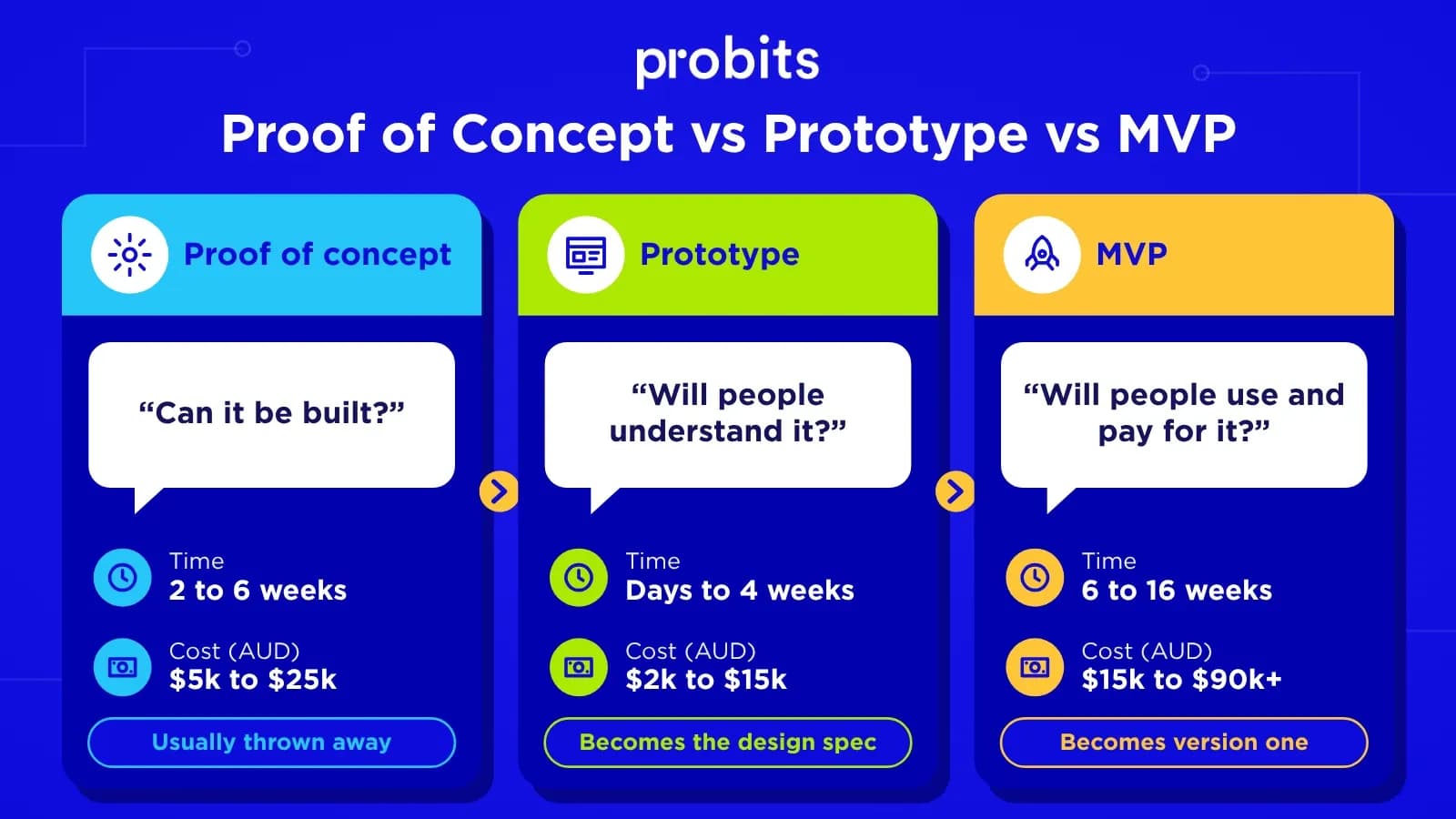
A proof of concept, a prototype and an MVP each answer a different question. A proof of concept asks whether the idea can be built. A prototype asks whether people understand how it works. An MVP asks whether people will use it, and ideally pay for it. Most founders who come to us already know they want an "MVP", and a fair few of them need one of the other two first.
That matters for your budget. A proof of concept for a startup idea might take a few weeks. A clickable prototype can take days. An MVP is usually a two to four-month build. Pick the wrong one and you either spend MVP money answering a prototype question, or launch a product that was never technically possible in the first place.
MVP vs Prototype vs Proof of Concept: The short answer
| Proof of concept (PoC) | Prototype | MVP | |
|---|---|---|---|
| Question it answers | Can this be built? | Will people understand and want to use it? | Will people use it and pay for it? |
| Who sees it | Your team, technical advisers, sometimes investors | Target users, investors, your designers and developers | Real customers |
| What it looks like | Rough code or a technical test, often with no real interface | Wireframes or a clickable design, usually with no working back end | A working product with one core workflow |
| Typical time | 2 to 6 weeks | A few days to 4 weeks | 6 to 16 weeks |
| Rough cost (AUD) | 5,000 to 25,000 | 2,000 to 15,000 | 15,000 to 90,000+ |
| What happens to it after | Usually thrown away | Becomes the design spec | Becomes version one of the product |
Those cost and time figures are rough planning ranges for an Australian build, not quotes. They move a lot with scope.
As a rule of thumb, build a PoC when the risk is technical, a prototype when the risk is usability, and an MVP when the risk is demand.
What is a Proof of Concept?
A proof of concept (PoC) is a small, focused test that shows whether a specific technical idea works. Nobody signs up for a PoC, and it usually has no design to speak of. Its job is to answer one question with evidence, so you don't bet a full build on an assumption.
"PoC" is just short for proof of concept. You'll see both used interchangeably in proposals and investor decks.
Say you're building an app that reads handwritten pathology request forms and pulls out the patient details automatically. The whole business depends on the extraction being accurate enough on messy, real-world forms. That's a PoC question. Before anyone designs a login screen, a developer takes 200 scanned forms, runs them through two or three extraction approaches, and measures how often each one gets the fields right. If the best result is 60% accurate, you've learned something important for a few weeks of work instead of a few months.
A PoC makes sense when:
- you're relying on an AI model, an algorithm or a data source you haven't tested on your own data
- you need two systems to talk to each other and you're not sure they can (an old practice management system with no public API, for example)
- performance is the risk: can it process 10,000 records in under a minute?
- an investor or a large customer wants evidence the core technology works before committing
Skip it when your product uses well-understood technology. A booking app, a marketplace or a CRM for tradies doesn't need a PoC. Thousands of those already exist, and the open question is whether people want yours.
PoC code is usually written fast and thrown away, which is fine as long as nobody talks you into "just building on top of" a PoC for your production product without rewriting it properly.
What about AI proofs of concept?
AI products are where we see PoCs pay for themselves most often. Large language models are easy to demo and hard to make reliable. An AI PoC should test your real inputs, measure accuracy against a set of examples you've checked by hand, and estimate the running cost per user. A demo that works on five hand-picked examples proves very little. If AI is the core of your product, AI development usually starts here.
What is a Prototype?
A prototype is a model of how the product will look and work, built so people can react to it before it's coded. It ranges from sketches on paper to a high-fidelity clickable design in Figma that looks almost exactly like the finished app.
Prototypes test the experience. Can a first-time user work out how to book an appointment, and where do they hesitate on the way?
Low-fidelity vs high-fidelity prototypes
| Low fidelity | High fidelity | |
|---|---|---|
| Looks like | Sketches, boxes and labels, grey wireframes | Close to the real app: colours, real copy, images |
| Takes | Hours to a few days | One to four weeks |
| Good for | Testing the flow and structure early | User testing, investor pitches, handing to developers |
| Watch out for | People struggle to imagine the finished product | People assume it's nearly built |
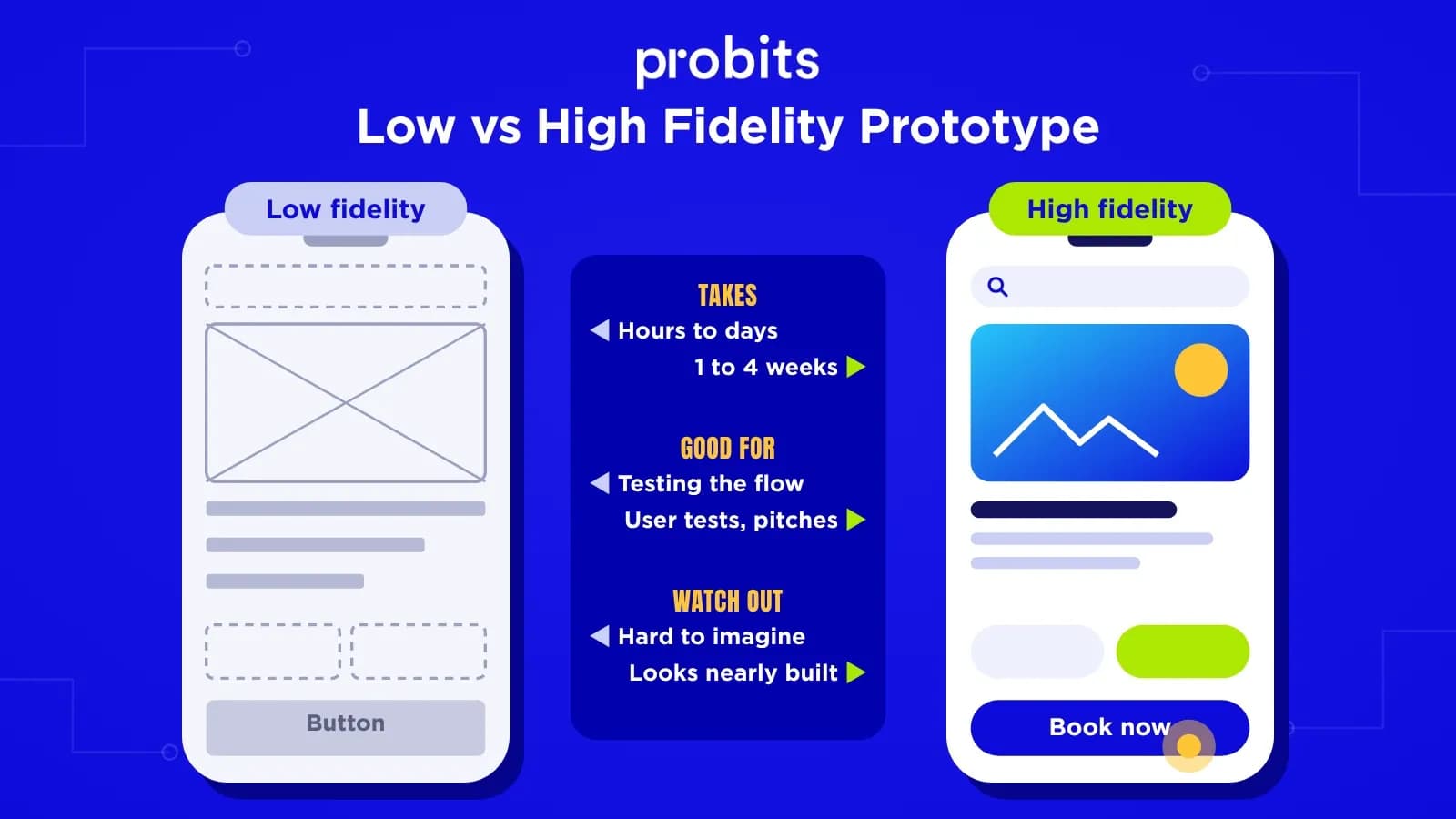
That last point catches founders out. Show an investor a polished clickable prototype and they may think you're weeks from launch, when there's no back end at all. Be clear about what it is.
Our view: for most MVPs, a clickable prototype tested with five to eight target users is the best value step in the whole process. It costs a fraction of development, and every problem you find in Figma is far cheaper to fix than the same problem found in code. Good UI/UX design work usually starts with exactly this.
AI design tools have made prototyping much faster too. You can now go from an idea to a working clickable demo in a day or two, and rapid prototyping with AI makes it cheap to test several versions with users before choosing one.
What is an MVP?
An MVP (minimum viable product) is the smallest version of your product that real customers can use to get real value, so you can learn whether the business works. It runs on working code with real users, and it's deliberately incomplete.
Unlike a prototype, an MVP has to work. Someone can sign up, complete the main task and get the result, without you standing next to them explaining which buttons don't do anything yet. Founders often stretch what a minimum viable product is to cover a nearly finished app, which defeats the point of building one.
An MVP doesn't always mean software. Dropbox's founder Drew Houston famously tested demand with a short demo video before the product was ready, and the beta waitlist grew from about 5,000 to 75,000 sign-ups overnight. A concierge service run by hand, or a landing page with a pre-order button, can also count as an MVP if it tests whether people will commit. There are several cheap ways of validating an MVP idea before you build anything.
When it is software, keep it to one core workflow. An MVP that tries to do everything costs more, and it's harder to tell which part is working. Scope is also the biggest driver of MVP development cost in Australia, so every feature you leave out shows up in the quote.
PoC vs MVP: What's the difference?
A PoC proves the technology works. An MVP proves the business works.
A PoC stays internal and usually ends up in the bin. An MVP goes in front of customers and becomes the foundation you build on. You can have a successful PoC and a failed MVP: the AI extraction works beautifully, but clinics won't change their process to use it. Some products need both.
Prototype vs MVP: What's the difference?
A prototype shows people what the product will be like. An MVP lets them use it.
Prototypes are for learning about the experience before you code, and they're cheap to change. MVPs are for learning about behaviour in the real world: do people come back, and do they pay? A user saying "I'd use this" while clicking through a prototype is a weak signal. A user paying for an MVP is a strong one.
Proof of concept vs prototype: What's the difference?
A proof of concept tests whether something can work, usually behind the scenes. A prototype tests how it will feel to use, usually on the surface.
They often run side by side. On the pathology form app, a developer could be running the extraction PoC while a designer builds a clickable prototype of the clinic dashboard. If both come back positive, you're in a good position to build the MVP.
Which should you build first?
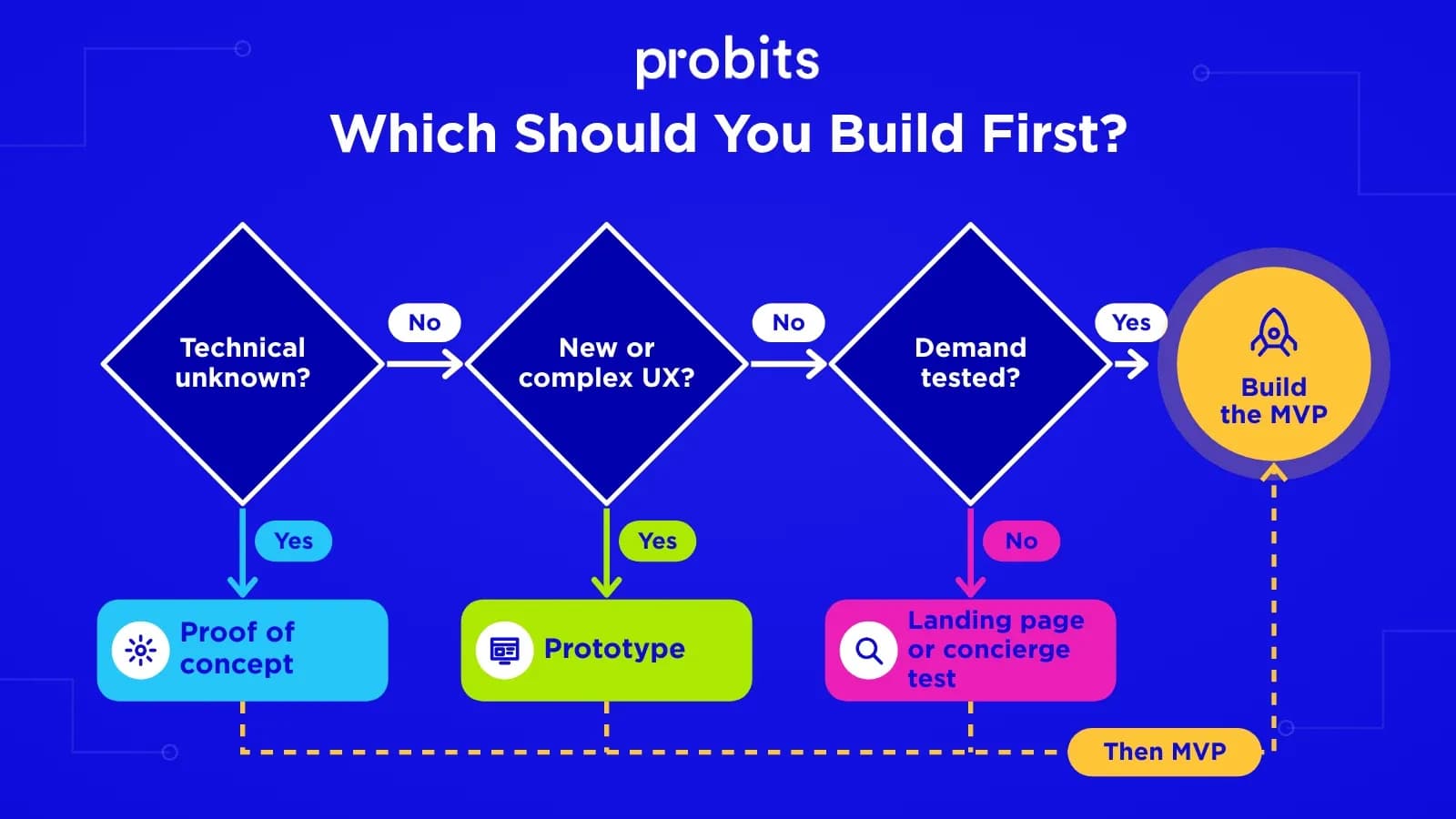
Work through these questions in order:
- Is there a real technical unknown? If your product depends on something unproven (an AI model on your data, a hard integration, unusual performance), start with a proof of concept.
- Is the user experience new or complicated? If users have to learn a new way of working, or the flow has lots of steps, build a clickable prototype and test it with five to eight target users.
- Have you tested demand? If you haven't, try a landing page, waitlist or concierge test before any code.
- Ready to build? Build the MVP around one core workflow, using what the PoC and prototype taught you.
Most of the products we see go prototype first, then MVP. A smaller number, usually AI or integration-heavy ones, need a PoC at the start. Very few need all three, and almost none need to skip straight to an MVP without at least a prototype.
| Your situation | Start with |
|---|---|
| "Can the AI actually do this on our data?" | Proof of concept |
| "Will clinics, tradies or customers understand the app?" | Prototype |
| "Investors want to see something" | Prototype (plus a PoC if the tech is unproven) |
| "We know it works and people want it; we need customers using it" | MVP |
| "A big customer wants evidence before signing" | PoC or pilot |
What about pilots, MLPs and MMPs?
You'll come across a few more terms in proposals:
- Pilot: a trial of a working product with one customer or a small group, often in a business setting. A hospital trialling software in one ward before rolling it out is running a pilot. It usually comes after the MVP.
- MLP (minimum lovable product): an MVP with more attention on design and delight, on the theory that "viable" isn't enough in crowded markets. Useful idea, but it can become an excuse to keep adding polish before launch.
- MMP (minimum marketable product): the first version you're ready to sell and market widely, usually after the MVP has been refined with user feedback.
How much does each cost in Australia?
As rough planning ranges for an Australian build:
- Proof of concept: AUD 5,000 to 25,000, depending on how hard the technical question is. AI PoCs that need data preparation sit at the higher end.
- Prototype: AUD 2,000 to 15,000. A low-fidelity wireframe set costs far less than a full high-fidelity clickable design with user testing.
- MVP: AUD 15,000 to 40,000 for a simple MVP with one core workflow, and AUD 40,000 to 90,000 or more for a standard MVP with payments and integrations.
Doing a prototype before your MVP usually saves more than it costs, because changes in design are cheap and changes in code aren't. Whichever you build, it's worth knowing what to look for when choosing an MVP development company, since the same questions apply to PoC and prototype work.
Can a prototype or PoC become the MVP?
A prototype can and should become the design spec for your MVP. Developers build from it directly, which saves time and avoids arguments about what was meant.
A PoC usually shouldn't become the MVP. It was written to answer a question quickly, not to be secure or maintainable. Reuse what you learned, and sometimes small pieces of the code, but expect the production version to be rebuilt properly.
The same goes for no-code or AI-built prototypes that turned out to work. They can be a great MVP for a while, but there's usually a point where moving from no-code to a production-ready app makes sense.
FAQs
Is an MVP the same as a prototype?
No. A prototype shows how the product will look and work but usually has no working back end. An MVP is a working product that real customers can use.
Do I need a proof of concept before an MVP?
Only if there's a real technical unknown, such as an AI model on your data or a difficult integration. Products built with well-understood technology can usually go straight to a prototype and then an MVP.
Which comes first, PoC, prototype or MVP?
Usually PoC (if needed), then prototype, then MVP. The PoC and prototype can also run at the same time when the technical and design questions are separate.
What does PoC stand for?
PoC stands for proof of concept: a small test that shows whether an idea is technically feasible before you commit to building it.
Can I show a prototype to investors?
Yes, and it's common at pre-seed stage. Be clear that it's a prototype, especially if it's high fidelity, so nobody mistakes it for a working product.
Not sure which one you need?
If you can describe your idea, we can usually tell you in one conversation whether the biggest risk is technical, usability or demand, and what the smallest useful first step looks like. Book a free consultation with our Australian-led team, or see how our MVP development team takes products from prototype to launch.